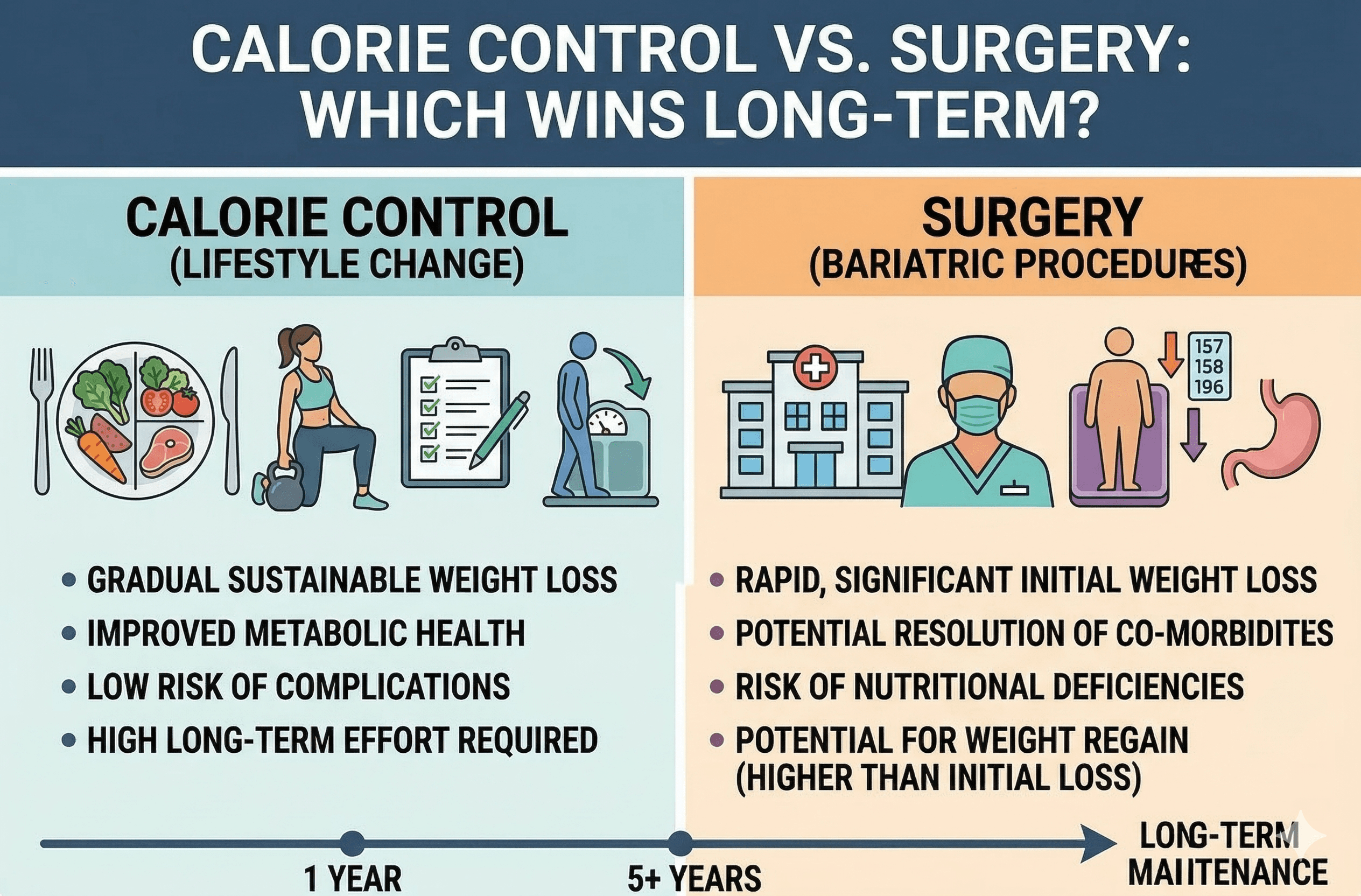
Calorie Control vs. Bariatric Surgery: Which Wins at Year 5?

Surgery patients and diet-only patients — 5 years later, here's who actually kept the weight off.
If you've spent any amount of time researching severe weight loss, you've probably heard the argument made with complete confidence: surgery just works better. It's faster, it's more dramatic, and for people carrying hundreds of extra pounds, it can feel like the only realistic path forward.
But here is what that argument quietly ignores: what happens after the operating room doors close. The five-year data tells a story that is far more complicated—and far more honest—than the highlight reel of before-and-after photos suggests.
The real question isn't which method produces the biggest number on the scale at month six. The real question is: who is still winning at year five?
ACT 1: The Long-Term Reality of Bariatric Surgery
Bariatric surgery — which includes procedures like Roux-en-Y gastric bypass, sleeve gastrectomy, and gastric banding — produces genuine, life-changing results in the short term. Patients frequently lose 60 to 80 percent of their excess body weight within the first 12 to 18 months. For people with severe, obesity-related health conditions like Type 2 diabetes, sleep apnea, or hypertension, those immediate results can be medically transformative.
But the five-year picture is where the conversation gets complicated.
The Data on Surgical Weight Regain
According to research published by the National Institutes of Health (NIH), a significant percentage of bariatric patients experience weight regain within five years of their procedure.
The Swedish Obese Subjects (SOS) study — one of the longest-running bariatric outcome studies ever conducted — tracked patients for up to 20 years. The researchers found that while surgery patients did maintain more weight loss than non-surgical controls over the long haul, weight regain was still substantial and nearly universal. On average, patients regained roughly one-third of the weight they had lost by the 10-year mark.
Gastric banding, once considered a gentler surgical option, showed even more sobering results, with high rates of regain and many patients eventually requiring band removal or revision surgery.
Why Does Regain Happen?
If the stomach has been physically altered, shouldn't overeating be impossible?
The answer is no. Surgery changes the anatomy, but it does not change the brain.
- Physical Adaptation: The stomach pouch can stretch over time if consistently overfilled. Furthermore, hunger hormones like ghrelin—which are initially suppressed after surgery—gradually normalize, bringing the appetite back.
- Psychological Reality: The emotional and behavioral patterns that drove the original weight gain (using food to cope with stress, trauma, or boredom) do not disappear on an operating table.
Patients who haven't done the hard work of rebuilding their relationship with food often find themselves returning to old habits. They learn how to "eat around" the surgery by grazing on high-calorie, easily digestible foods throughout the day.
ACT 2: What Diet-Only Success Looks Like — And What It Demands
On the other side of the debate, diet-only weight loss has its own complicated reputation. The statistics are frequently cited and notoriously discouraging: it is commonly stated that 80 to 95 percent of dieters regain lost weight within five years.
Because of this, calorie-restricted diets are often painted as inherently temporary—a white-knuckle effort of willpower that can't possibly compete with a surgical intervention.
But that framing misses something vital. Those failure statistics lump together every person who went on a two-week crash diet, every chronic yo-yo dieter, and every person who abandoned a New Year's resolution by February. They do not accurately portray what structured, behaviorally supported, long-term lifestyle change can achieve.
The Behavioral Blueprint of the Successful
Consider the National Weight Control Registry (NWCR), an ongoing study tracking over 10,000 people who have lost significant weight (an average of 66 lbs) and kept it off long-term. The majority of these members lost weight without surgery.
When researchers look at this group, they don't find people relying on magic pills or extreme restriction. They find people who share highly consistent behavioral traits:
- They weigh themselves regularly to catch small upward trends early.
- They eat breakfast daily to stabilize morning hunger.
- They exercise consistently (averaging about an hour of moderate activity per day).
- They maintain a high level of self-monitoring (like tracking their food intake).
These are not people who found a "trick." They are people who fundamentally changed their identity and how they live. Long-term, non-surgical success is absolutely real. It is just demanding in a way that isn't fast or glamorous.
ACT 3: The Verdict — Behavior Is the Variable That Actually Matters
Here is what five years of clinical data and decades of obesity research are trying to tell us: The method of weight loss is less predictive of long-term success than the behavior that surrounds it.
Surgery patients who receive robust psychological support, commit to dietary restructuring, and maintain regular physical activity keep more weight off than surgery patients who treat the operation as a standalone cure. Conversely, diet-only patients who build sustainable habits and address emotional eating succeed where others fail.
The 5 Pillars of Long-Term Maintenance
Regardless of whether you choose surgery or calorie control, these five behaviors are what actually dictate your success at year five:
Consistent Self-Monitoring: Whether it's tracking macros, keeping a food journal, or weekly weigh-ins, maintaining awareness of your intake allows you to course-correct before a 5-pound regain becomes a 50-pound regain.
Psychological Support: Obesity is rarely just a math problem involving calories. Food is deeply tied to emotional regulation. Cognitive Behavioral Therapy (CBT) is one of the most underutilized, highly effective tools for long-term weight maintenance.
A Sustainable Dietary Structure: The people who succeed long-term aren't the ones who swear they will never eat pizza again. They are the ones who build a dietary framework they can maintain across years—through holidays and stressful seasons—without it feeling like a punishment.
Physical Activity as Identity: Movement cannot be viewed as a punishment for eating. It must become part of who you are. Regular physical activity is one of the strongest predictors of long-term weight maintenance, regardless of surgical status.
A Supportive Environment: Environment shapes behavior far more reliably than willpower. This includes the people you surround yourself with, the food you keep in your kitchen, and the systems you build to make healthy choices the default option.
Maryland Trim Clinic (MTC) in Laurel, MD
Whether you are trying to avoid surgery, preparing for a procedure, or struggling with weight regain years after an operation, you do not have to navigate the complexities of severe weight loss alone. Sustainable success requires a clinical partner who understands that obesity is a metabolic and behavioral issue, not a moral failing.
At the Maryland Trim Clinic (MTC) in Laurel, MD, patients receive comprehensive, medically supervised care tailored to their unique biology and lifestyle. If you are looking for a non-surgical path, MTC offers a highly structured medical weight loss program designed to help you achieve significant results safely. For those who need advanced metabolic support, the clinic provides monitored GLP-1 weight loss injections to help manage appetite and insulin resistance effectively.
Because long-term maintenance requires more than just medication or a meal plan, the team also focuses heavily on nutritional counseling and coaching. This ensures you build the psychological and behavioral habits necessary to keep the weight off at year five, year ten, and beyond. By partnering with the Maryland Trim Clinic, you gain the medical oversight and personal accountability needed to fundamentally change your health trajectory.
The Bottom Line
Surgery can be a incredibly powerful tool. For the right candidate, with the right support, it can be genuinely life-saving. But the data makes it undeniably clear: surgery is an intervention, not a permanent cure.
Calorie control and lifestyle change, when executed with structure and genuine behavioral investment, can produce durable long-term results without a surgical assist. The limitation is rarely the method itself; the limitation is the depth of your commitment to changing how you think, how you cope, and who you decide to become in the process.
Five years from now, the people still winning aren't necessarily the ones who chose the most aggressive medical intervention. They are the ones who did the hardest work—the psychological and behavioral work that happens long after the scale stops moving so quickly.
Frequently Asked Questions
Q: Do bariatric surgery patients regain weight after 5 years? A: Yes, weight regain is very common. Studies show that most patients regain a significant portion of their lost weight by the five-year mark, with some research indicating an average regain of roughly one-third of the lost weight by year ten. This happens because surgery cannot fix underlying behavioral habits or emotional eating patterns.
Q: Can you lose a significant amount of weight without surgery? A: Absolutely. While it requires sustained behavioral commitment, significant long-term weight loss without surgery is entirely achievable. The National Weight Control Registry tracks thousands of individuals who have lost substantial weight and maintained it for years through habits like self-monitoring, regular exercise, and structured eating.
Q: What is the biggest predictor of long-term weight loss success? A: Research consistently points to behavioral factors rather than the method of weight loss itself. Key predictors include consistent self-monitoring (like tracking food or weight), psychological support, sustainable dietary habits, regular physical activity, and modifying your home environment to support healthy choices.
Q: Why do people regain weight after bariatric surgery? A: Regain occurs for both physical and psychological reasons. Physically, the stomach pouch can stretch over time, and hunger hormones (like ghrelin) that are initially suppressed post-surgery gradually normalize. Psychologically, patients who haven't addressed their emotional eating triggers often revert to old habits, finding ways to "eat around" the surgery by grazing on calorie-dense foods.
Q: Is surgery or diet better for someone with severe obesity? A: There is no universal answer. According to the Centers for Disease Control and Prevention (CDC), safe weight loss requires a comprehensive approach. Surgery can be the appropriate choice for patients with serious obesity-related health complications (like severe diabetes), provided it is combined with behavioral support. Diet-only approaches can work brilliantly for those with the right level of commitment and structure. The most important factor is the consistency of the lifestyle changes you make alongside your chosen method.
Ready to Build Your Long-Term Strategy?
Would you like me to help you draft a 5-step checklist for auditing your current kitchen environment to make healthy choices easier?