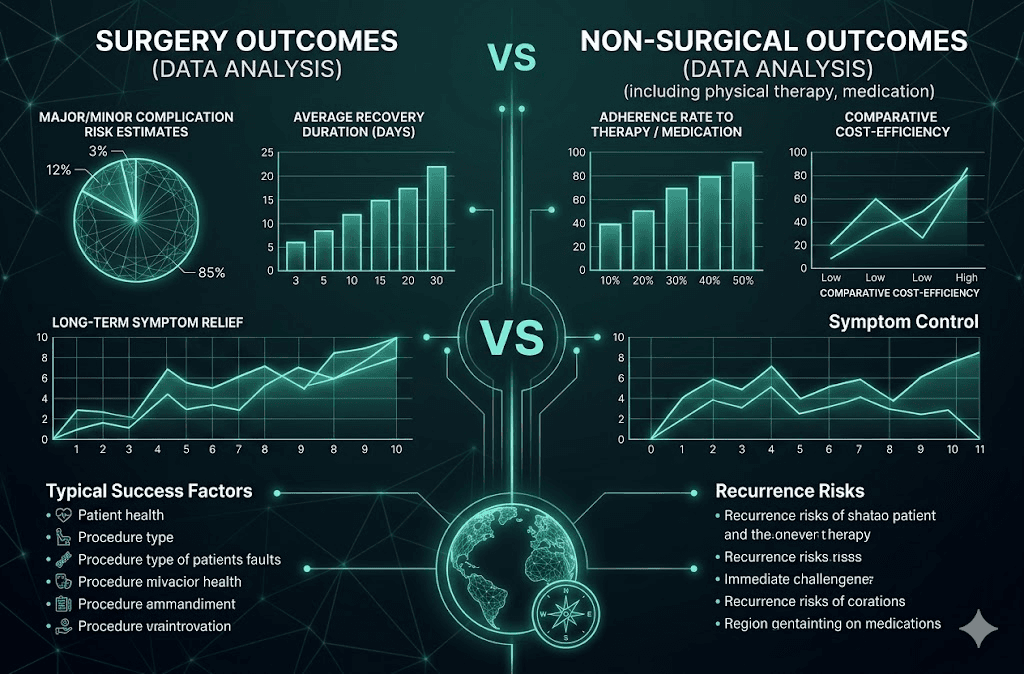
Weight Loss Surgery vs. No Surgery: What the Data Really Says

Some patients lose more weight without surgery than those who get it. Here's why.
If that sentence surprised you, you are not alone—and that reaction is exactly the problem. Most people enter the weight loss conversation with a mental hierarchy already built: surgery is the "serious" option, the one reserved for when nothing else works, and the only one that actually delivers permanent results. Non-surgical methods are often viewed as slower, weaker, and ultimately inferior.
But the clinical data doesn't support that hierarchy. Not cleanly. Not across the board.
This isn't an argument against surgery. For the right patient, at the right time, with the right medical support system, bariatric surgery is a legitimate, life-saving tool. But it is an argument against assumption—the assumption that the scalpel is the absolute ceiling of what's possible, and that lifestyle change is just what you do while waiting to qualify for the "real" solution.
Let's pull back the curtain on what the long-term research actually says.
ACT 1: The Long-Term Numbers — Surgery vs. Medically Supervised Programs
When most people think about bariatric surgery outcomes, they picture the highlight reel: dramatic transformations in the first 12 to 18 months, with patients losing 30%, 40%, or even 50% of their excess body weight. Those numbers are real. And they are incredibly impressive.
But weight loss research has a dirty little secret: the 1-year photo is not the whole story.
What the Swedish Obese Subjects (SOS) Study Found
The SOS study is one of the most respected, long-term bariatric surgery datasets in existence. It tracked over 4,000 patients for up to 20 years, comparing those who had bariatric surgery against those who received conventional, non-surgical obesity treatment.
According to research highlighted by the National Institutes of Health (NIH), the data showed a sobering reality about surgical weight regain:
- At 2 years: Surgical patients had lost an average of 23% of their body weight.
- At 10 years: That figure had dropped back to approximately 17%.
- At 20 years: It settled around 18%—a meaningful, sustained loss, but a far cry from the peaks of year two.
Meanwhile, the non-surgical group showed modest results on average—but "on average" does a lot of heavy lifting. Because averages mask outliers. And in the non-surgical group, some of those outliers were quietly achieving massive, permanent success.
The DiRECT Trial — Dietary Intervention That Rivaled Surgery
Published in The Lancet in 2018, the DiRECT (Diabetes Remission Clinical Trial) study examined whether an intensive, structured dietary intervention could achieve Type 2 diabetes remission—a milestone long considered the exclusive territory of bariatric surgery.
The results were striking:
- 46% of participants in the dietary intervention group achieved full remission of Type 2 diabetes at one year.
- 86% of those who lost 15kg (33 lbs) or more achieved remission.
- The program used a structured, low-calorie diet followed by a gradual food reintroduction phase. There was no surgery, no hospital stay, and no lifetime micronutrient supplementation required.
For context, bariatric surgery achieves diabetes remission in roughly 50–80% of patients. The DiRECT trial's non-surgical approach landed right in the same statistical neighborhood.
What About Medically Supervised Programs?
Very Low Calorie Diet (VLCD) programs, when delivered with consistent medical oversight, behavioral coaching, and structured follow-up, have been shown to produce 15–25% total body weight loss in motivated participants over 12–24 months.
This overlaps significantly with many surgical outcomes—particularly for sleeve gastrectomy at the 3-to-5-year mark, once natural weight regain begins factoring in. The LABS (Longitudinal Assessment of Bariatric Surgery) study found that up to 30% of gastric bypass patients had regained a substantial portion of their lost weight within 5 years.
When measured at 5+ years rather than 12 months, the gap between surgical and non-surgical outcomes is considerably narrower than the cultural narrative suggests.
ACT 2: When Non-Surgical Patients Win — And What They Have in Common
Let's be specific about what "non-surgical patients outperforming surgical ones" actually looks like in practice.
Clinicians who run long-term weight management programs have documented cases where non-surgical participants outpaced surgical patients at the 5-year mark regarding total weight maintained. These are not unicorns. They appear with enough regularity to identify clear behavioral patterns.
So, what do these highly successful patients have in common?
1. Structured, Consistent Accountability
The single most common thread in non-surgical success stories is not willpower—it's structure. These patients had regular check-ins with a clinical care team: dietitians, physicians, and coaches. The accountability wasn't self-imposed; it was externally scaffolded until it became an internalized habit. Surgical patients often receive intensive follow-up in year one, but then it tapers off. Non-surgical patients who succeed maintain professional contact much longer.
2. Behavioral Therapy as a Core Component
In successful non-surgical cases, behavioral therapy wasn't just a checkbox; it was treated as equal in importance to the dietary prescription. Patients actively worked on:
- Identifying emotional eating triggers.
- Developing new coping mechanisms for stress.
- Restructuring their psychological relationship with food.
3. A Sustainable Nutritional Framework
These patients weren't on perpetual starvation diets. They moved through intentional phases: an initial caloric deficit, structured reintroduction, and a long-term maintenance plan that allowed for flexibility. They understood that losing weight and maintaining weight require two completely different skill sets.
4. Hormonal and Metabolic Awareness
Successful non-surgical patients understood their individual hormonal landscape. Variables like thyroid function, insulin resistance, and cortisol patterns were monitored and addressed by medical professionals. In recent years, many are supported by pharmacological tools (like GLP-1 receptor agonists) that address metabolic barriers without the need to permanently alter their anatomy.
5. Environmental Restructuring
They didn't just change what they ate; they changed their environment. They changed what was available in their pantry, how stress was managed in their households, and what role food played in their social lives. Environment is the invisible variable that most weight loss conversations completely ignore.
ACT 3: What Surgery Cannot Fix — The Honest Verdict
Here is where we have to be completely direct.
Bariatric surgery is a powerful metabolic tool. It alters gut hormones and physically restricts intake. For patients with a BMI over 40 (or over 35 with significant comorbidities), according to guidelines from the Centers for Disease Control and Prevention (CDC), it can reduce mortality risk in ways that dietary intervention alone may not match at the same speed.
But here is what surgery cannot do:
- Surgery cannot reprogram your relationship with food. Post-surgical patients who have unaddressed binge eating disorders or emotional eating patterns will find workarounds. The physical restriction fades over time as the stomach stretches.
- Surgery cannot resolve your environment. If you return to the same high-stress job and the same sleep-deprived routine that contributed to your weight gain, surgery provides a temporary ceiling, but not a permanent floor.
- Surgery cannot substitute for an identity shift. The patients who sustain their results long-term—surgical or non-surgical—are those who fundamentally changed how they see themselves. That cognitive reframe is a function of sustained psychological work, not anatomy.
Maryland Trim Clinic (MTC) in Laurel, MD
If you are weighing your options between surgical and non-surgical paths, the most important decision you can make is finding a clinical partner who understands the complexities of both. Sustainable weight loss requires a team that looks at your metabolism, your hormones, and your habits, rather than just offering a one-size-fits-all procedure.
At the Maryland Trim Clinic (MTC) in Laurel, MD, patients have access to an evidence-based, medically supervised environment designed to produce dramatic results without the scalpel. MTC offers a highly structured medical weight loss program tailored to your specific biology. For those who need metabolic support to match the appetite-suppressing effects of surgery, the clinic provides monitored GLP-1 weight loss injections.
Because long-term maintenance requires structural behavioral change, the MTC team also provides dedicated nutritional counseling and coaching. Furthermore, if you are dealing with hormonal barriers that make weight loss nearly impossible, their expertly managed hormone replacement therapy can help optimize your metabolism. By partnering with the Maryland Trim Clinic, you receive the comprehensive accountability and medical tools necessary to rival surgical outcomes safely and sustainably.
The Bottom Line: What's the Verdict?
The honest answer is this: the best option is the one paired with the most rigorous behavioral and lifestyle intervention. Surgery without that foundation eventually produces weight regain. Non-surgical approaches built on that foundation can produce results that rival or exceed surgical outcomes at the 5-to-10-year mark.
If you are considering surgery, the data says: do the behavioral work before and after the operation. It is not an afterthought. If you are pursuing a non-surgical path, the data says: don't go it alone. Structure, accountability, and professional medical support are what separate the outliers who succeed from those who plateau.
The scalpel is not the ceiling. And it was never supposed to be.
Frequently Asked Questions
Q: Is bariatric surgery more effective than non-surgical weight loss methods? A: In the short term (12–24 months), bariatric surgery typically produces much faster and greater weight loss. However, long-term data shows meaningful weight regain in a significant percentage of surgical patients. Non-surgical programs that incorporate structured behavioral support, medical supervision, and GLP-1 medications can produce comparable results at the 5-to-10-year mark for motivated patients.
Q: What does the research say about weight regain after bariatric surgery? A: Multiple large-scale studies indicate that 20–30% of bariatric surgery patients regain a substantial portion of their lost weight within 5 years. Weight regain is most strongly associated with the re-emergence of pre-surgical behavioral patterns, a lack of continued follow-up care, and unaddressed psychological factors like emotional eating.
Q: Can non-surgical programs achieve results comparable to surgery for conditions like Type 2 diabetes? A: Yes. The DiRECT trial showed that an intensive, structured dietary intervention achieved full Type 2 diabetes remission in 46% of participants—a figure that approaches the lower range of surgical outcomes. Patients who lost 15kg (33 lbs) or more had an 86% remission rate.
Q: What are the key factors that allow non-surgical patients to outperform surgical ones? A: Clinical observation points to five core factors:
Sustained, structured accountability with a medical care team.
Behavioral therapy treated as a primary component.
A phased, sustainable nutritional framework.
Medical management of hormonal and metabolic variables.
Deliberate restructuring of the patient's social and physical environment.
Q: Should I avoid bariatric surgery based on this information? A: Not necessarily. For patients with a BMI over 40 (or 35 with severe comorbidities), surgery may provide rapid metabolic and mortality benefits that diet alone cannot match. The key takeaway is that surgery is an intervention, not a cure. It is only effective long-term when paired with rigorous behavioral support—the exact same support required to succeed without surgery.
Ready to Explore Your Non-Surgical Options?
If you're ready to build a sustainable, medically supervised weight loss plan that goes beyond temporary fixes, the team at Maryland Trim Clinic is here to help. Contact us today to schedule a personalized consultation and discover how comprehensive care, behavioral coaching, and metabolic support can help you reach your goals safely.