What Peptides Actually Do Inside Your Body | The Science Explained

Medical Disclaimer: The information in this article is for educational purposes only and does not constitute medical advice. Peptides and hormonal therapies can have significant effects on the body. Always consult with a licensed healthcare provider before starting any new supplement, longevity protocol, or medical treatment.
Peptides are frequently called anti-aging "cheat codes", but nobody explains what they actually do once they're inside your body. That gap between hype and biological understanding is costing people real money, time, and in some cases, the actual results they could have achieved if they simply knew what they were working with.
If you've ever stared at a skincare label listing "Matrixyl" or read about BPC-157 on a wellness forum and thought, I should probably try this, without fully grasping the mechanism, this article is the one you needed first.
Let's fix the knowledge gap. From the moment a peptide enters your body to the cellular chain reaction it sets off, here is exactly what is happening — and why it matters for every health and beauty choice you make.
ACT 1: Your Body Already Speaks Peptide — It Just Needs the Right Words
The Biology of Cellular Messaging
To understand what peptides do, you first need to understand what they are at a fundamental, biological level.
A peptide is a short chain of amino acids — the exact same building blocks that make up proteins. The primary difference is size: proteins are long, complex chains (think hundreds to thousands of amino acids), while peptides are short, typically ranging from 2 to 50 amino acids. That small size is not a limitation; it's the entire point.
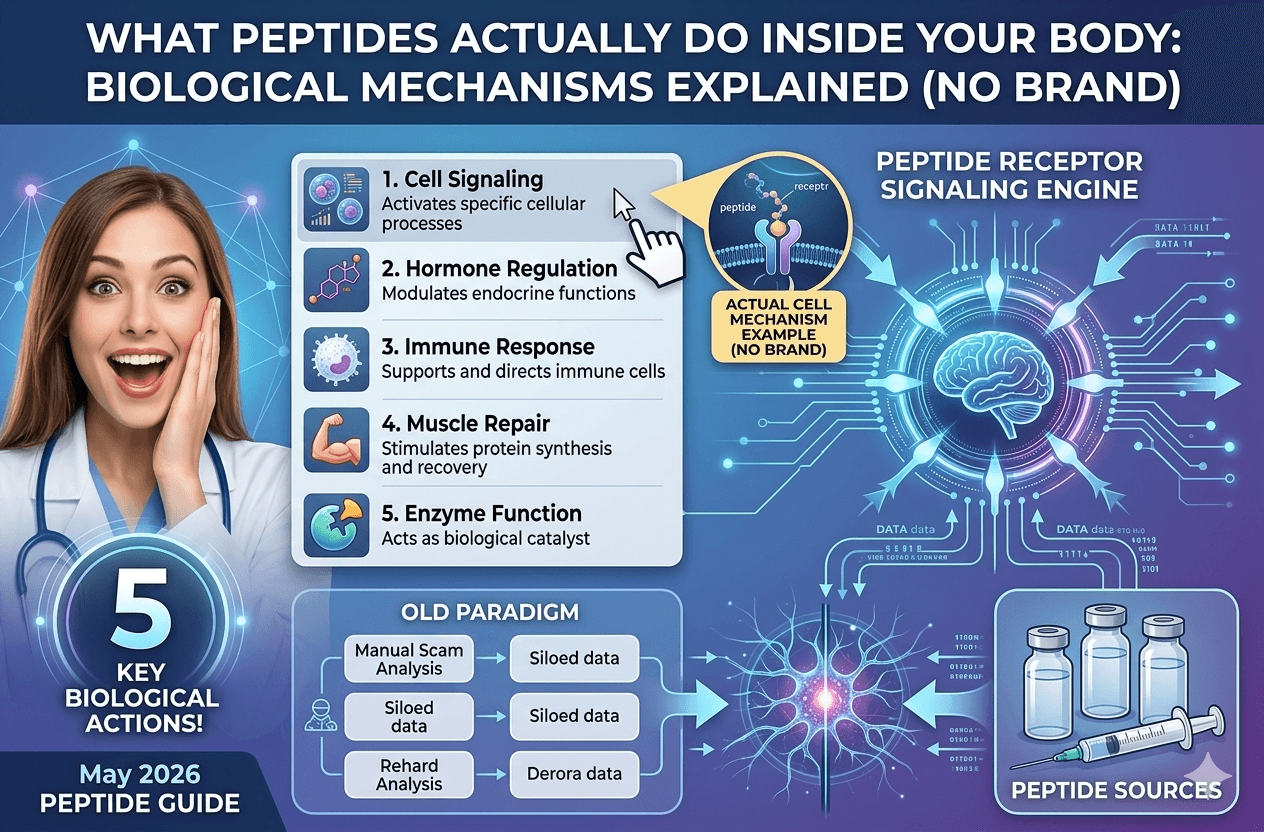
Your body uses peptides constantly as signaling molecules. They act as biological text messages sent between cells to coordinate everything from immune responses and tissue repair to hormone release. Insulin is a peptide. So are endorphins. Your body is, in a very real sense, already fluent in this language.
When you introduce an exogenous (externally sourced) peptide — whether through skincare, an oral supplement, or an injection — you are essentially sending your body a message it already knows how to read. The peptide binds to a specific receptor on the surface of a target cell, triggering an intracellular cascade that ultimately changes how that cell behaves.
The Collagen Signal: A Concrete Example
Let's make this tangible. Collagen is the structural protein responsible for skin firmness, joint integrity, and connective tissue strength. As you age, your fibroblast cells (the factories responsible for producing collagen) slow down. Part of this slowdown is triggered by a feedback loop: as collagen breaks down, fragments called matrikines are released.
One of the most heavily studied matrikines is a tripeptide (a three-amino-acid chain) called GHK (glycine-histidine-lysine). According to research published by the National Institutes of Health (NIH), GHK has a well-documented ability to stimulate blood vessel and nerve outgrowth, increase collagen and elastin, and support tissue repair.
- The Aging Problem: When your skin is young, GHK levels are high. As you age, GHK levels drop. The body interprets low GHK as a sign that collagen isn't needed—a self-reinforcing cycle of decline.
- The Peptide Solution: When you introduce a GHK-based peptide (like GHK-Cu, the copper-bound version), you are spoofing that signal. The fibroblasts detect GHK, interpret it as evidence that collagen turnover is needed, and upregulate production. You aren't forcing the cell to do something unnatural; you are restoring a communication signal that time had silenced.
This same logic applies across dozens of applications: growth hormone secretagogues signal the pituitary gland; thymosin beta-4 signals repair cells to migrate toward damaged tissue; and BPC-157 upregulates growth factor receptors involved in healing. The peptide is the messenger that initiates the action.
ACT 2: Where the Peptide Goes Determines Everything It Can Do
This is where consumer confusion thrives, and it's the single most important concept to grasp before spending money. Delivery method is not a minor detail. It determines whether the peptide reaches its intended target at all.
Topical Peptides: The Skin-Deep Reality
The skincare industry has built a multi-billion-dollar market on peptide-infused creams and serums. Products containing Matrixyl or Argireline are backed by credible research, but that research is often conducted on isolated cell cultures in a lab.
The real-world limitation is the skin barrier. Your stratum corneum (the outermost layer of skin) is specifically designed to keep foreign substances out. Most peptides are too large and too water-attracting to penetrate meaningfully past this barrier on their own.
- How Science Adapts: Formulation science uses lipid conjugation (attaching a fatty acid chain like palmitoyl) or encapsulation technologies (like liposomes) to help peptides pass through the lipid-rich skin barrier.
- The Realistic Ceiling: Topical peptides primarily work at the epidermal and shallow dermal level. They can stimulate surface-layer fibroblasts, temporarily relax superficial facial muscles, and improve local hydration. These effects are real, but they are localized and modest compared to systemic treatments.
Injectable and Oral Peptides: Systemic Access and Systemic Responsibility
Injectable peptides bypass the skin barrier entirely. Subcutaneous or intramuscular injections deposit the peptide directly into tissue where it can enter the bloodstream and bind to receptors throughout the body. This is why injectable growth hormone secretagogues (like Ipamorelin or CJC-1295) produce measurable systemic changes in body composition, sleep architecture, and recovery speed.
Oral peptides present a much more hostile picture. The gastrointestinal tract is designed to destroy them. Stomach acid and digestive enzymes aggressively break peptide bonds, often degrading a peptide into individual amino acids before it can be absorbed. Oral bioavailability for most therapeutic peptides is extremely low.
However, specific exceptions exist:
- Hydrolyzed Collagen: Clinical trials demonstrate that specific di- and tri-peptides (like prolyl-hydroxyproline) can survive digestion, enter the bloodstream, and stimulate fibroblast activity in the skin and joints.
- BPC-157: Preclinical studies suggest it may have unusual stability in the GI environment, though human clinical data remains limited.
Safety Note: Because systemic peptides alter cellular and hormonal functions, the U.S. Food and Drug Administration (FDA) tightly regulates them, and has raised safety concerns regarding unregulated, compounded peptides. Systemic peptides should only be used under strict medical supervision.
ACT 3: Sequence and Length — Why the Specific Peptide You Choose Matters Enormously
Not all peptides are interchangeable. Two peptides can both be broadly described as "collagen-boosting" but have completely different effects based on their amino acid sequence.
Amino Acid Sequence Is the Message
A peptide's biological activity is determined by its specific sequence of amino acids. Think of it like a lock and key. A peptide with the sequence Lys-Thr-Thr-Lys-Ser fits specific receptors on fibroblasts involved in collagen production. Change even one amino acid, and you may have a molecule that fits no receptor at all—or fits the wrong one.
Comparing peptides by category alone is meaningless. For example, Ipamorelin and GHRP-6 are both growth hormone secretagogues. But while GHRP-6 significantly stimulates ghrelin receptors (causing intense hunger and potential cortisol elevation), Ipamorelin is far more selective, stimulating GH release with minimal side effects.
Length Affects Both Specificity and Stability
Peptide length interacts with function in two vital ways:
Specificity: Shorter peptides (like dipeptides) have fewer distinguishing structural features and may degrade quickly. Longer peptides (10–50 amino acids) fold into complex shapes for highly specific receptor binding, but are more vulnerable to enzymatic breakdown. The "sweet spot" for many therapeutic applications is 3–15 amino acids.
Modifications: The palmitoyl group added to skincare peptides isn't just cosmetic; it changes the peptide's lipophilicity for better skin penetration. Structural modifications can dramatically change a peptide's real-world effectiveness without altering its core sequence.
What This Means for Your Choices
When evaluating any peptide product or therapy, run it through this three-point checklist:
- Identify the specific sequence: Vague terms like "regenerative peptide" are marketing fluff. Look for the exact name, mechanism of action, and human clinical data.
- Match the delivery to the target: Topical application for systemic effects is useless. Injectable delivery for a surface-level skin goal is excessive.
- Verify purity and source: Peptide synthesis is complex. Impurities are common in the unregulated supplement market. For clinical use, pharmaceutical-grade sourcing and third-party testing are non-negotiable.
Maryland Trim Clinic (MTC) in Laurel, MD
Understanding the science behind peptides is only the first step; translating that science into safe, measurable results requires professional clinical oversight. If you are exploring the systemic benefits of peptide therapies, metabolic optimization, or longevity protocols, working with a qualified medical provider is essential to ensure you are receiving pure, accurately dosed, and appropriate treatments.
At the Maryland Trim Clinic (MTC) in Laurel, MD, patients have access to an evidence-based, medically supervised environment. Whether you are seeking to optimize your cellular health through balanced hormone replacement therapy, looking for comprehensive support via a tailored medical weight loss program, or simply wanting to look and feel your best as you age, clinical precision matters. The team at Maryland Trim Clinic cuts through the wellness hype, focusing instead on targeted therapies, lab-guided protocols, and holistic care to help your body function at its absolute peak.
The Bottom Line
Peptides are not magic, nor are they mere marketing hype. They are a sophisticated biological communication system that your body already uses continuously. When the right peptide, in the right form, reaches the right tissue, the results can be genuinely impressive: collagen production is stimulated, tissue repair is accelerated, and metabolic pathways are optimized.
But none of that happens automatically just because a label says "peptide." The mechanism demands respect, the delivery demands precision, and the sequence demands specificity.
Now that you understand what peptides actually do inside your body, you are no longer guessing. You are making decisions the way the science was always meant to inform them.
Frequently Asked Questions
Q: What is a peptide and how is it different from a protein?
A: A peptide is a short chain of amino acids, typically between 2 and 50 units long. A protein is a much longer, more complex chain—often hundreds to thousands of amino acids—that folds into intricate three-dimensional structures. Both are made of the same building blocks, but peptides are small enough to function as targeted signaling molecules, acting as biological messengers that trigger specific cellular responses.
Q: Do topical peptides in skincare actually work?
A: Yes, with caveats. Topical peptides have legitimate research supporting their ability to stimulate fibroblast activity and support collagen synthesis at the epidermal and shallow dermal levels. However, their penetration through the skin barrier is limited. Well-formulated products with lipid-conjugated peptides or encapsulation technology perform best, but expect modest, localized improvements rather than dramatic, systemic changes.
Q: Are injectable peptides safe to use?
A: Injectable peptides carry a different risk profile than topical or oral options. Safety depends heavily on the specific peptide, dosage, source quality, and your individual health status. While some peptides have established safety profiles in clinical settings, others rely primarily on animal data. Because of contamination risks and hormonal impacts, anyone considering injectable peptides must consult a qualified medical provider.
Q: Do oral collagen peptides actually reach the skin and joints?
A: Yes. Multiple randomized controlled trials have shown that hydrolyzed collagen peptides—particularly small di- and tri-peptides like prolyl-hydroxyproline—can survive digestion, be absorbed through the intestinal lining, appear in the bloodstream, and stimulate fibroblast activity in skin and connective tissue. Effective research doses typically range from 2.5 to 10 grams daily.
Q: What is a growth hormone secretagogue and how does it differ from taking growth hormone directly?
A: A growth hormone secretagogue (like Ipamorelin or CJC-1295) is a peptide that signals your pituitary gland to produce and release more of your own growth hormone. This works within your body's natural feedback loop; if levels get too high, the body can still pump the brakes. Injecting synthetic human growth hormone (HGH) directly bypasses this feedback loop entirely, carrying a much higher risk of side effects like insulin resistance and hormonal disruption.
Q: How long does it take for peptides to show results?
A: The timeline varies significantly by peptide type and delivery method. Topical skincare peptides may show subtle texture improvements in 4–8 weeks. Oral collagen peptides typically show measurable effects after 8–12 weeks of daily use. Systemic peptides prescribed for recovery or body composition generally require 3–6 months of consistent, supervised use to yield substantial physical changes.
Ready to Optimize Your Cellular Health?
Would you like me to help you draft a list of questions to ask a medical provider during your first consultation regarding peptide therapies or longevity treatments?