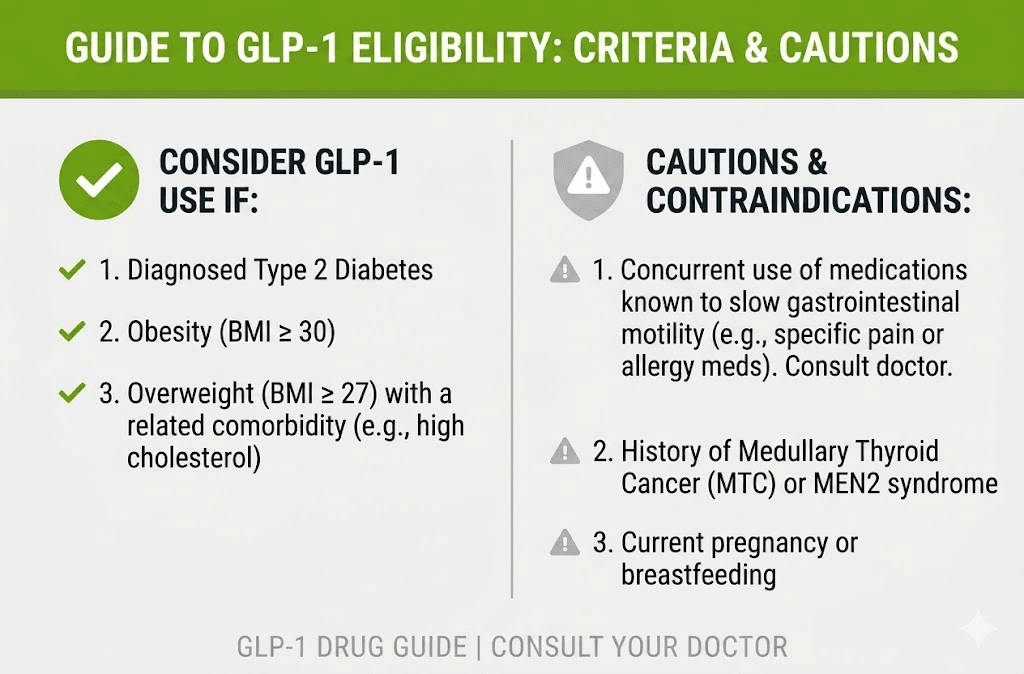
Who Should and Shouldn’t Take GLP-1 Drugs: A Criteria Guide

GLP-1 drugs aren't for everyone — and prescribing them to the wrong person can do real harm.
Over the past few years,appetite suppressant medications like semaglutide (Ozempic, Wegovy) and tirzepatide (Mounjaro, Zepbound) have moved from niche diabetes treatments to cultural phenomena. Celebrity endorsements, viral before-and-after posts, and a flood of telehealth prescriptions have created the impression that these drugs are a universal solution to weight struggles.
They are not. Behind the headlines is a precise clinical framework designed to identify who genuinely benefits—and who faces unnecessary, sometimes serious, risk. The National Institute of Diabetes and Digestive and Kidney Diseases (NIDDK) stresses that these medications are intended for specific medical profiles, not cosmetic use. If you're weighing whether a GLP-1 medication belongs in your health plan, this breakdown is your starting point.
ACT 1: The Clinical Criteria — Who Actually Qualifies
The BMI Threshold
The most widely used entry point for GLP-1 candidacy is Body Mass Index (BMI). Current FDA-approved labeling for weight management indications generally requires:
- BMI ≥ 30 (classified as obesity),OR
- BMI ≥ 27 (classified as overweight) plus at least one weight-related comorbidity.
This threshold exists for a medical reason. Clinical trials demonstrating safety and efficacy were conducted strictly on populations within these BMI ranges. Using them outside those parameters means operating without robust evidence and potentially exposing patients to side effects without a proportional health benefit.
It's worth noting that BMI is an imperfect tool. It doesn't account for muscle mass or fat distribution. A person with a BMI of 27 who carries significant visceral fat around their organs may carry more metabolic risk than someone with a BMI of 31 who is physically active. This is why clinicians are increasingly looking at waist circumference and advanced metabolic testing and analysis alongside BMI when making candidacy decisions.
The Comorbidity Requirement
For individuals in the overweight category (BMI 27–29.9), qualification typically hinges on the presence of at least one weight-related health condition. The conditions that most commonly qualify include:
- Type 2 diabetes or prediabetes (GLP-1 drugs were originally developed for glycemic control)
- Hypertension (high blood pressure)
- Dyslipidemia (abnormal cholesterol or triglyceride levels)
- Obstructive sleep apnea * Cardiovascular disease * Non-alcoholic fatty liver disease (NAFLD)
The presence of these conditions doesn't just justify treatment—it often amplifies the benefit. Someone managing type 2 diabetes, hypertension, and excess weight simultaneously may see clinical improvements across all three with a single medication.
ACT 2: Who Should Avoid GLP-1 Drugs
Absolute Contraindications (The "Hard Stops")
Some individuals should not take GLP-1 medications under any circumstances:
- Personal or family history of medullary thyroid carcinoma (MTC): Animal studies found that GLP-1 receptor agonists caused thyroid C-cell tumors in rodents. The FDA has placed a black box warning on these medications for this risk. Anyone with a personal history of MTC or Multiple Endocrine Neoplasia syndrome type 2 (MEN2) should not take these drugs.
- Pregnancy and breastfeeding: Weight loss is not recommended during pregnancy, and the effects on fetal development are not sufficiently studied. Women are advised to discontinue these medications at least two months before attempting conception.
- Severe gastrointestinal disease: Patients with a history of gastroparesis (delayed gastric emptying), severe GERD, or significant small bowel disease face elevated risks. Because GLP-1 drugs intentionally slow gastric motility, they can seriously worsen pre-existing GI conditions.
High-Risk Populations Requiring Extreme Caution
- History of pancreatitis: Anyone with a prior episode of acute or chronic pancreatitis should have a detailed risk-benefit conversation with their physician before starting treatment. Many clinicians consider active pancreatitis a functional contraindication.
- Eating disorder history: This is one of the most underappreciated risk categories. GLP-1 drugs suppress appetite dramatically and alter the psychological relationship with food. For individuals with a history of anorexia, bulimia, or other restrictive eating disorders, this mechanism can be highly destabilizing.
- Low BMI or healthy weight individuals: Perhaps the most concerning trend in GLP-1 prescribing is their use by people who are not clinically overweight. Driven by aesthetic goals rather than medical need, these individuals face the real risks of muscle mass loss, nutritional deficiency, and bone density reduction without a legitimate therapeutic target to justify it.
- Older adults with sarcopenia risk: Muscle mass naturally declines with age. Aggressive weight loss without adequate protein intake and resistance exercise can accelerate sarcopenia (muscle loss). GLP-1 medications in older adults should always be paired with muscle building and toning protocols.
ACT 3: The Lifestyle Baseline — What Has to Be in Place First
Medication is not a replacement for behavior. This is the message that gets lost in the cultural conversation around GLP-1 drugs, and it's arguably the most important one.
Why Lifestyle Foundation Matters
GLP-1 medications create a window—a period of reduced appetite and altered food preferences that makes behavior change significantly easier. But they do not install new habits automatically. Patients who enter treatment without a nutritional framework tend to lose weight initially and then plateau, or struggle massively when they discontinue the drug.
Studies on semaglutide discontinuation are instructive: participants who stopped taking the medication regained approximately two-thirds of their lost weight within a year. When the medication was removed, the old appetite returned. This is a predictable outcome when medication is used without concurrent lifestyle restructuring.
The Non-Negotiable Basics:
- Protein intake: Because the drug reduces total caloric intake significantly, the risk of muscle loss is real. Aim for 1.2 to 1.6 grams of protein per kilogram of body weight daily.
- Resistance training: Cardio alone is insufficient. Strength training signals the body to preserve muscle during a caloric deficit.
- Sleep and stress management: GLP-1 drugs cannot override the hormonal disruption caused by chronic sleep deprivation or unmanaged stress (which spikes cortisol and drives fat storage).
Maryland Trim Clinic (MTC) in Laurel, MD
Determining if you are a candidate for a weight loss medication is a highly personalized medical decision. Located in Laurel, MD, the Maryland Trim Clinic (MTC) provides the comprehensive medical evaluation necessary to ensure that you are receiving the right treatment for your specific metabolic profile.
At MTC, we do not believe in a one-size-fits-all approach. If you are exploring GLP-1 weight loss injections, our clinical team will carefully review your medical history to rule out contraindications. Furthermore, if you are a candidate, you will be enrolled in a holistic medical weight loss program that includes ongoing nutritional counseling and coaching. This ensures that while the medication manages your appetite, you are actively building the behavioral and dietary foundations required to sustain your health long-term.
The Honest Conversation
GLP-1 medications represent a genuine advancement in metabolic medicine. For the right candidate—someone with obesity-related health conditions, the appropriate physiological profile, and the commitment to building supporting habits—they can be life-changing. As noted by the Centers for Disease Control and Prevention (CDC), obesity is a complex chronic disease that requires evidence-based, clinical intervention.
But the category of "right candidate" is specific. The question is never simply do I want to lose weight? The question is whether the clinical criteria are met, whether contraindications have been properly ruled out, and whether the behavioral scaffolding is in place to make the medication work.
Medical Disclaimer: The information provided in this article is for educational purposes only and is not intended as a substitute for professional medical advice, diagnosis, or treatment. Always seek the advice of your physician regarding a medical condition, treatment options, or before altering your prescribed medication routine.
Frequently Asked Questions
Q: What BMI do you need to qualify for GLP-1 weight loss medication? A: The general FDA-approved criteria require a BMI of 30 or higher, or a BMI of 27 or higher combined with at least one weight-related health condition such as type 2 diabetes, hypertension, or dyslipidemia.
Q: Can people with a history of eating disorders take GLP-1 drugs? A: This is considered a high-risk situation. GLP-1 medications dramatically suppress appetite and can alter the psychological relationship with food in ways that may destabilize individuals with a history of restrictive eating disorders. Thorough mental health screening is essential before prescribing.
Q: Why do people regain weight after stopping GLP-1 medications? A: GLP-1 drugs suppress appetite through a pharmacological mechanism. When the medication is discontinued, that mechanism is removed, and pre-existing appetite patterns return. Without accompanying lifestyle changes, most weight lost during treatment is regained within a year of stopping.
Q: Are GLP-1 drugs safe for older adults? A: They can be, but require additional caution. Older adults are at greater risk of sarcopenia (muscle mass loss), which can be accelerated by significant caloric reduction. Prescribing in older populations should always be paired with high protein intake targets and a structured resistance training program.
Q: What lifestyle changes are necessary while taking GLP-1 medications? A: At a minimum: adequate protein intake (typically 1.2–1.6g per kilogram of body weight daily), regular resistance training to preserve muscle mass, sufficient sleep, and consistent medical monitoring. Medication without these foundations produces an increased risk of muscle loss and weight regain.
Q: Who should absolutely not take GLP-1 drugs? A: Absolute contraindications include individuals with a personal or family history of medullary thyroid carcinoma or Multiple Endocrine Neoplasia syndrome type 2 (MEN2), pregnant or breastfeeding women, and those with severe gastroparesis or significant small bowel disease.
Ready to Find Out if GLP-1s Are Right for You?
Choosing the right medical weight loss path requires expert clinical guidance. Visit the Maryland Trim Clinic homepage today to schedule a comprehensive evaluation. Our medical team in Laurel, MD, will review your health history and help you build a safe, personalized strategy for your metabolic goals.