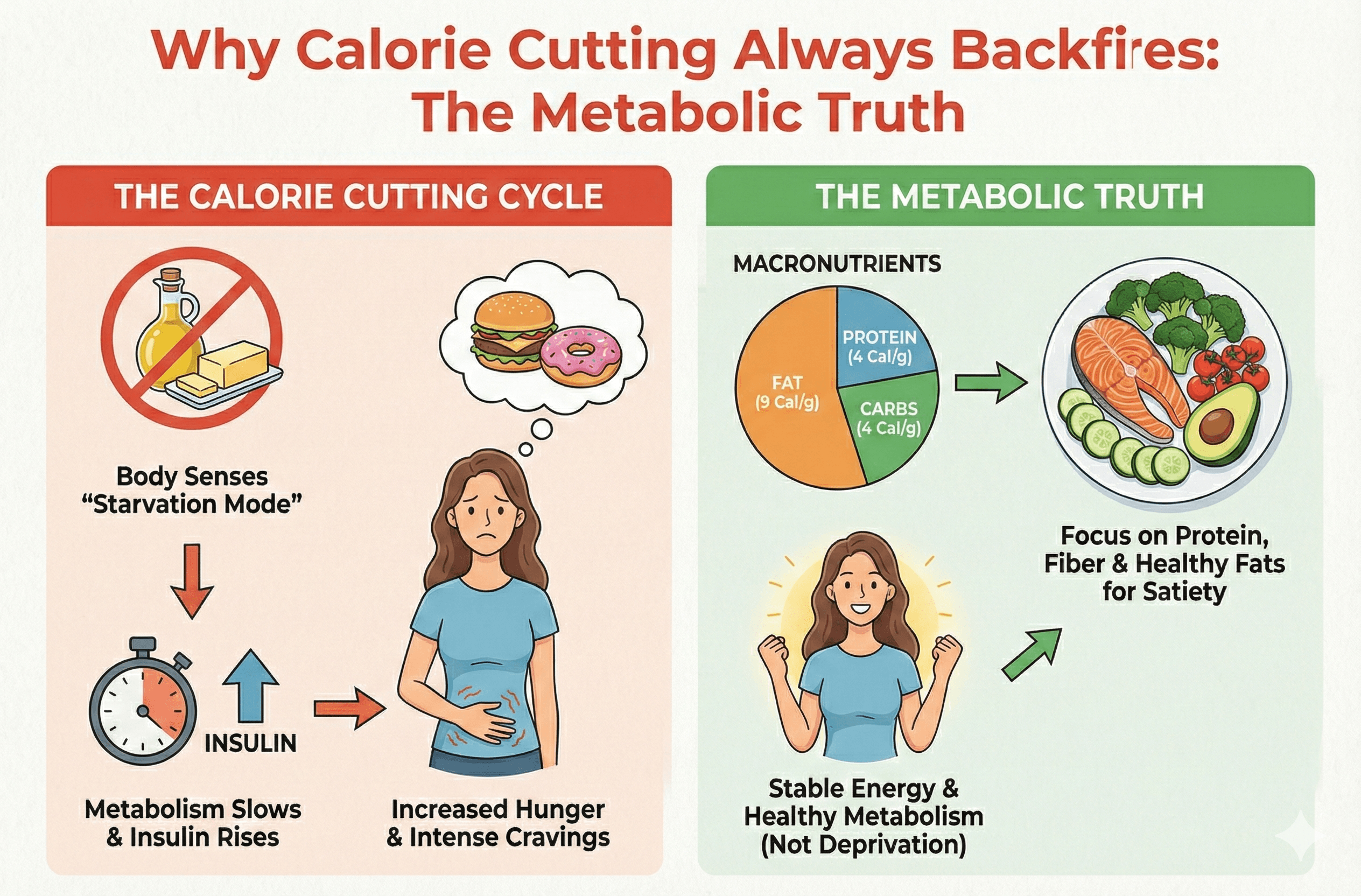
Why Calorie Cutting Always Backfires: The Metabolic Truth

Cut calories, lose weight, gain it all back. Here's the metabolic reason your body fights you.
You've been there before: religiously tracking every calorie, white-knuckling through hunger pangs, and watching the scale drop for a few weeks or months. Then, something shifts. The weight loss stalls. The hunger becomes unbearable. Eventually, the pounds creep back—often bringing friends.
When this happens, you likely blame your willpower, your discipline, or a fundamental inability to "just eat less."
But according to Dr. Jason Fung, a nephrologist and author of The Obesity Code, the problem isn't you. It is the entire calorie-restriction paradigm. Your body isn't broken; it is responding exactly as evolution designed it to when faced with perceived starvation.
Understanding the biological mechanisms behind this metabolic rebellion isn't just intellectually interesting—it is the key to breaking the yo-yo cycle that has defined your relationship with food and weight.
The traditional "calories in, calories out" model seems mathematically sound: create a deficit, lose weight. But human metabolism isn't a simple calculator. It is a complex hormonal and neurological system designed to defend your body weight at all costs.
Getty Images
Here is why calorie restriction always backfires, and what is actually happening inside your body when you diet.
Act 1: Your Hunger Hormones Declare War
The moment you cut calories, your body initiates a coordinated hormonal response that makes sustained weight loss nearly impossible. This isn't a design flaw—it is a survival mechanism honed over millions of years of evolution.
The Ghrelin Spike
Ghrelin, the hunger hormone, goes into overdrive. Research on participants from The Biggest Loser study revealed that ghrelin levels remained elevated even six years after their dramatic weight loss. Contestants who had successfully lost hundreds of pounds through extreme calorie restriction and exercise experienced hunger signals 50% higher than before they started dieting. Their bodies were screaming for food with an intensity that never diminished, creating a constant biological pressure to regain the lost weight.
Dr. Fung explains this as your body's "famine response." When calorie intake drops, your brain interprets this as a threat to survival. It doesn't distinguish between a deliberate diet and an actual famine. The hypothalamus responds by ramping up production of ghrelin while simultaneously reducing sensitivity to leptin—the satiety hormone that signals fullness.
Leptin Resistance: The Missing "Off Switch"
Leptin resistance creates a perfect storm. Before dieting, your fat cells produce leptin in proportion to their size, telling your brain, "We have adequate energy stores; no need to eat."
But chronic calorie restriction disrupts this signaling. Your leptin levels drop as you lose fat, which normally increases appetite—but the problem goes deeper. Your brain becomes less responsive to whatever leptin remains, a condition called leptin resistance. You lose the biological "off switch" that would normally tell you to stop eating.
This hormonal double-punch—elevated hunger signals plus diminished satiety signals—creates what feels like insatiable hunger. And here is the cruel irony: the more weight you lose through calorie restriction, the stronger these hormonal changes become. Your body ratchets up the biological pressure in direct proportion to your "success."
Why Willpower Fails: Willpower cannot override biology indefinitely. This is the critical insight that Dr. Fung emphasizes. Dieters who regain weight aren't weak or undisciplined. They are fighting a neuroendocrine system that is designed to win. You can resist hunger for days, weeks, or even months. But you cannot resist altered hormone levels forever. Eventually, biology wins. The only question is when, not if.
Act 2: The Insulin Resistance Connection
Hormonal hunger signals are only part of the story. Dr. Fung argues that the real driver of weight regain isn't calories themselves—it is insulin, the master fat-storage hormone.
The Role of Insulin in Fat Storage
Insulin determines whether you burn or store fat. When insulin levels are elevated, your body is locked in storage mode. Fat cells take up glucose and fatty acids from the bloodstream and lock them away.
Even if you are eating fewer calories, chronically high insulin levels prevent you from accessing stored body fat for energy. You are simultaneously starving (in terms of available energy) and unable to access your own fat stores.
This is why Dr. Fung emphasizes that "it's not about how much you eat, but what you eat and when you eat."
- A 1,500-calorie diet of refined carbohydrates will keep insulin chronically elevated.
- A 1,500-calorie diet of whole foods (with adequate protein and fat) allows insulin to drop between meals, creating windows where fat burning can actually occur.
The Trap of Insulin Resistance
Insulin resistance creates a vicious cycle. Many chronic dieters—especially those with a history of yo-yo dieting—develop insulin resistance. Their cells become less responsive to insulin's signals, so the pancreas compensates by producing even more insulin.
This creates a metabolic trap: high insulin levels prevent fat burning, which leads to persistent hunger despite adequate calorie intake. This drives further eating and, ultimately, weight gain.
Why Calorie Counting Ignores Insulin: Calorie restriction doesn't address insulin resistance. In fact, if you cut calories by eating frequent, small meals of carbohydrate-heavy foods (the classic "grazing" approach many dietitians used to recommend), you are maintaining elevated insulin levels throughout the entire day. You might create a calorie deficit on paper, but metabolically, your body remains trapped in fat-storage mode.
Quick Swaps to Lower Insulin:
- Instead of: Low-fat fruit yogurt (high sugar, spikes insulin) → Try: Full-fat Greek yogurt with nuts.
- Instead of: Grazing on 6 small meals a day → Try: Eating 2 to 3 satisfying, protein-heavy meals to allow insulin to drop.
- Instead of: Calorie-counting a bagel → Try: Eating a cheese and vegetable omelet (similar calories, much lower insulin response).
Act 3: Your Metabolism Slows to a Crawl
Even if you could somehow overcome the hunger hormones and the insulin resistance, there is a third biological mechanism that dooms calorie restriction: metabolic adaptation, also known as adaptive thermogenesis.
The Downward Thermostat
Your body actively reduces its energy expenditure to match your new, lower intake. When you cut calories, your metabolism doesn't stay constant. It slows down. This isn't a small effect—studies show resting metabolic rates can drop by 20–30% or more during sustained calorie restriction.
Your body reduces energy expenditure across multiple systems:
- Basal metabolic rate decreases: Your cells literally burn less energy at rest.
- Body temperature drops: You feel cold more easily as your body conserves heat.
- NEAT plummets: Non-exercise activity thermogenesis (unconscious movements like fidgeting and postural changes) decreases dramatically.
- Exercise efficiency improves: You burn fewer calories doing the exact same workout because your body becomes highly efficient at conserving fuel.
- Hormonal shifts: Thyroid hormone production decreases, further slowing your baseline metabolism.
Dr. Fung describes this as your body's "thermostat" adjusting downward. If you cut intake to 1,500 calories while your body normally burns 2,000, you might lose weight initially. But within weeks or months, your metabolism downregulates to match the new intake. Now you are only burning 1,500 calories. The deficit disappears, weight loss stalls, but you are still hungry and eating far less than before you started dieting.
The Permanent Damage of "Eat Less, Move More"
The traditional weight-loss advice assumes you have a fixed metabolism. But metabolic adaptation means the target keeps shifting. You cut calories, metabolism drops. You cut more calories, metabolism drops further. You add exercise, and your metabolism compensates by reducing spontaneous activity. You are running on a treadmill that keeps speeding up, requiring more and more restriction to achieve fewer and fewer results.
Dr. Fung argues that this approach is doomed by design. You cannot win a fight against metabolic adaptation. Your body will always defend its "set point" weight by reducing energy expenditure to match reduced intake.
The Way Forward: Rethinking the Paradigm
If calorie restriction triggers hunger hormones, maintains insulin resistance, and slows metabolism, what is the alternative? Dr. Fung's approach focuses on addressing the underlying hormonal dysfunction rather than simply reducing calories:
- Address Insulin First: Reduce refined carbohydrates and sugar to lower insulin levels. Focus on whole foods, adequate protein, and healthy fats that don't spike insulin.
- Use Intermittent Fasting: Creating extended periods without eating allows insulin levels to drop significantly, enabling fat burning and potentially reversing insulin resistance. Fasting also prevents metabolic slowdown in ways that continuous, daily calorie restriction doesn't.
- Prioritize Food Quality Over Quantity: The hormonal response to food matters more than the caloric content. Whole, unprocessed foods create stable blood sugar and sustained satiety.
The message for chronic dieters is both sobering and hopeful: calorie restriction as a long-term strategy fails not because you lack discipline, but because it triggers biological mechanisms designed to restore lost weight.
Your body isn't broken; the method is.
Maryland Trim Clinic (MTC) in Laurel, MD
If you are exhausted by the cycle of calorie counting and want to address the hormonal root causes of your weight plateau, the Maryland Trim Clinic (MTC) in Laurel, MD, offers a science-backed approach to metabolic health. They understand that overcoming insulin resistance and metabolic adaptation requires more than just a generic diet plan; it requires targeted, individualized medical care.
The team at MTC utilizes advanced tools like metabolic testing and analysis to see exactly how efficiently your body is burning fuel. From there, they can guide you through a customized medical weight loss program. For patients struggling with severe hormonal roadblocks, MTC also offers advanced interventions, including GLP-1 weight loss injections, which work to regulate the very hunger hormones (like ghrelin) that traditional dieting disrupts. By focusing on your unique biology, MTC helps you work with your metabolism, rather than against it.
Conclusion
The scale might tell the same disappointing story of regained weight, but the explanation isn't your failure. It is biology. Once you understand the biological mechanisms at play—ghrelin spikes, insulin resistance, and adaptive thermogenesis—you can finally stop blaming yourself and start addressing the actual problem.
By shifting your focus from "how much" you eat to "what and when" you eat, you can begin to heal your metabolism and break the yo-yo dieting cycle for good.
Medical Disclaimer: The information provided in this article is for educational purposes only and does not constitute medical advice. Always consult with a qualified healthcare professional before making significant changes to your diet, fasting routines, or starting any new weight loss program, especially if you have underlying health conditions like diabetes.
Frequently Asked Questions
Q: Does calorie restriction work for anyone long-term? A: Research from institutions like the National Institutes of Health (NIH) shows that only a very small percentage of people who lose significant weight through simple calorie restriction maintain that loss beyond five years. This isn't due to a lack of willpower; the biological mechanisms (elevated hunger hormones, metabolic slowdown, and insulin resistance) make long-term success extremely difficult without addressing underlying hormones.
Q: How long does metabolic adaptation last after dieting? A: Studies, including the famous Biggest Loser research, show that metabolic suppression can persist for six years or longer after extreme calorie restriction ends. However, approaches like intermittent fasting and correcting insulin resistance can help restore normal metabolic function over time.
Q: What does Dr. Fung recommend instead of calorie counting? A: Dr. Fung advocates addressing insulin resistance as the primary strategy. This includes reducing refined carbohydrates and sugar, eating whole unprocessed foods, incorporating intermittent fasting to lower insulin levels, and prioritizing when you eat just as much as what you eat.
Q: Can you reverse metabolic damage from yo-yo dieting? A: Yes, though it requires a different approach than continued calorie restriction. Extended fasting periods and reducing meal frequency have been shown to help maintain or even increase metabolic rate while allowing for fat loss. The key is working with your hormones to restore normal function.
Q: Why do some people maintain weight loss successfully? A: The small percentage of people who maintain weight loss long-term often share common factors: they successfully addressed underlying insulin resistance (often unintentionally through dietary changes), they made sustainable lifestyle changes rather than relying on sheer restriction, or they utilized methods that didn't trigger severe metabolic adaptation.
Ready to Fix Your Metabolism?
Stop fighting your biology and start healing it. If you are tired of restrictive diets that inevitably fail, it’s time to take a medical approach to your weight and hormonal health. Partner with the experts to build a sustainable plan tailored to your body. Visit Maryland Trim Clinic to Book Your Consultation Today