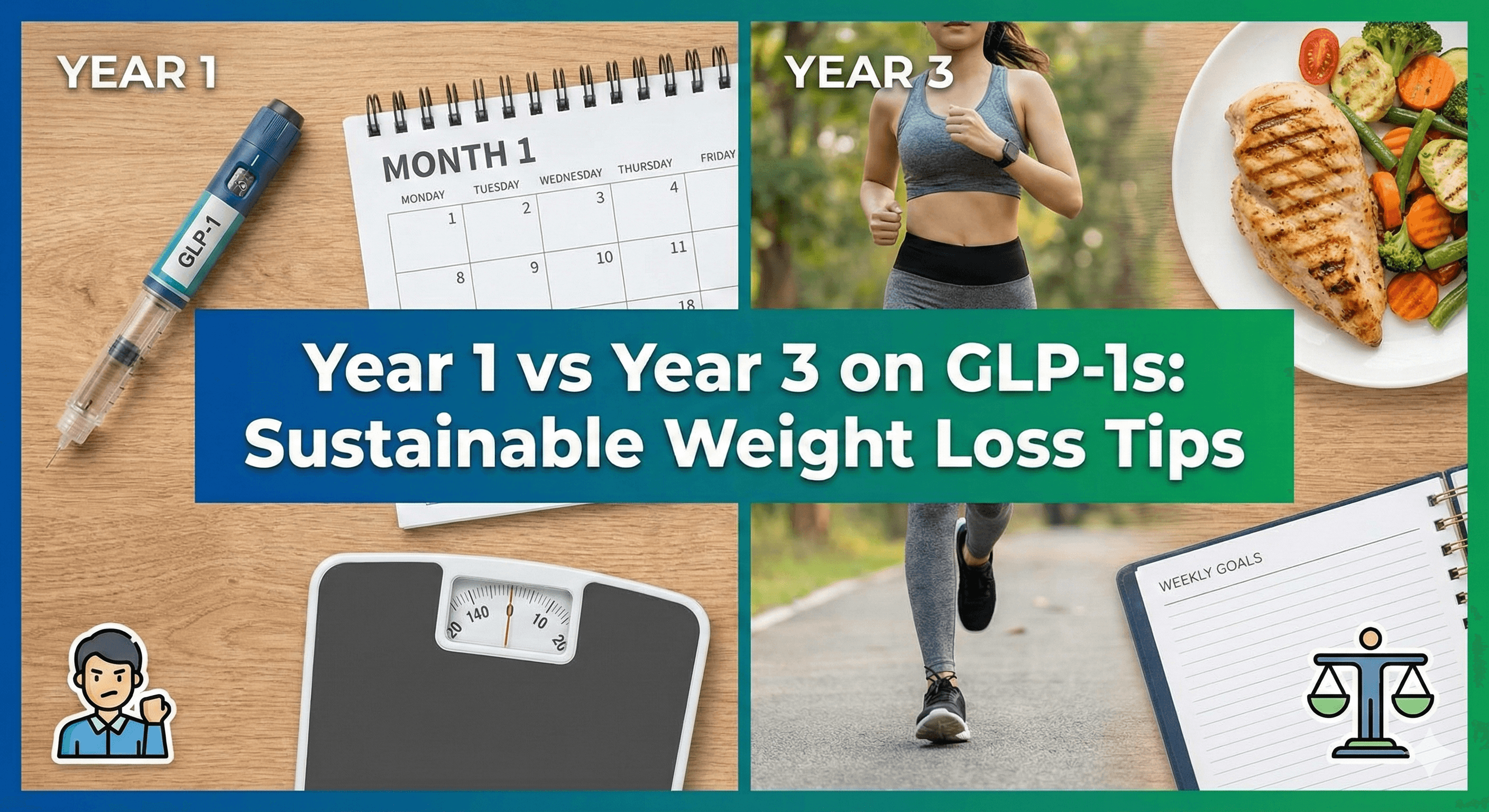
Year 1 vs Year 3 on GLP-1s: Sustainable Weight Loss Tips

What I wish I knew before starting GLP-1s—3 years of lessons
Three years ago, I started my first GLP-1 medication with high hopes and a prescription pad. Today, I'm still on the same class of medication, but almost everything else about my approach has changed. The reality nobody tells you when you're holding that first injection pen is that Year 1 and Year 3 look completely different—and not just on the scale.
If you're considering long-term GLP-1 use or are already several months in, you're likely facing a frustrating gap: most guidance focuses on getting started, not staying the course. Clinical trials publish 68-week data. Your endocrinologist has a 15-minute slot. But what happens in Year 2? Year 3? When does the honeymoon end, and what comes next?
This guide breaks down the long-term reality of GLP-1 medications through three critical phases: the mistakes that haunt you later, the biological shifts nobody warns you about, and the habits that ultimately matter more than the medication itself.
Common Mistakes in Year One That Affect Long-Term Success
The Protein Deficit Trap
In Year 1, I lost 45 pounds. I also lost muscle mass I'm still trying to rebuild in Year 3. The appetite suppression was so powerful that I routinely ate 800-1000 calories daily, felt fine, and assumed that was sustainable. It wasn't.
GLP-1s don't just reduce appetite—they make you indifferent to food. That indifference doesn't distinguish between the foods you should skip and the nutrients you desperately need. According to research published by the National Institutes of Health (NIH), rapid weight loss without proper nutritional intervention often leads to a significant reduction in lean muscle mass. If you don't prioritize resistance training and adequate protein, you risk losing strength along with the fat.
Quick Check: Are You Protecting Your Muscle?
- Aim for a Target: Consume at least 0.7–1g of protein per pound of your goal body weight.
- Eat Protein First: Fill up on protein before moving to carbs or fats to ensure you hit your macro goals before getting too full.
- Supplement Smartly: Use protein shakes or clear protein drinks if solid food feels too heavy. Getting proactive support through nutritional counseling and coaching can also help you design a realistic eating plan.
By Year 3, I'm still working to reverse the muscle loss from Year 1. The scale victory feels hollow when you've sacrificed metabolic health and strength to achieve it.
Chasing the Dosage Dragon
Every time my weight loss plateaued in Year 1, I asked for a dose increase. My doctor complied. I went from the lowest dose to the maximum dose in six months, always chasing that initial rapid drop.
The Problem: I was treating a chronic medication like a sprint. By maxing out dosage early, I left myself nowhere to go when tolerance inevitably developed. In Year 2, I faced a choice: switch medications, add another drug, or accept that weight loss would slow significantly.
What Works Better: * Wait it out: Plateau periods of 4-6 weeks are entirely normal.
- Look beyond the meds: Before increasing your dose, adjust your calories, sleep, stress management, or exercise routine.
- Increase slowly: Only move up a dose when genuinely necessary, not at the very first sign of slowing weight loss.
Ignoring the Lifestyle Foundation
Year 1 felt like magic. I ate less without trying, cravings disappeared, and weight fell off. I didn't build habits because I didn't think I needed to—the medication was doing the work.
The Reckoning in Year 3: GLP-1s absolutely reduce appetite and food noise, but they don't teach you what to eat, how to manage stress without food, or how to enjoy movement. When medication response dims—and it does for many people—you're left scrambling to develop skills you should have been building all along.
The people who succeed long-term start habit-building on Day 1, treating the medication as a tool that makes healthy behaviors easier, not a replacement for them.
The Side Effect Dismissal
Nausea, constipation, fatigue—I pushed through all of it in Year 1, convinced these were temporary prices for weight loss. Some were temporary. Others became chronic issues that now require their own management strategies.
What I Learned: Side effects that persist beyond 8-12 weeks won't magically resolve. They require intervention. Suffering through them doesn't build character; it builds resentment and reduces medication adherence.
Strategies for Managing Side Effects:
- Constipation: Implement daily fiber supplements and strict hydration protocols.
- Nausea: Speak to your provider about anti-nausea medication or strategic dose splitting (if approved by your doctor).
- Fatigue: Ensure you are eating enough calories and consider asking for bloodwork to check for nutrient deficiencies.
How Medication Response Changes Over Extended Use
The Tolerance Reality
This is the part nobody wants to talk about, but it's critical for long-term users: medication response changes. Not everyone experiences this, but enough do that it warrants an honest discussion.
My Experience: The appetite suppression that felt overwhelming in Months 1-6 became moderate in Year 2 and subtle in Year 3. I didn't regain weight, but maintaining required more conscious effort. The "food noise" returned at a lower volume than pre-medication, but it returned.
What the Research Suggests: Some studies indicate a partial tolerance to GLP-1 effects over time, though significant weight regain typically occurs when medication is stopped, not while continuing it. The medication still works—it just doesn't feel as dramatically effective as it once did.
Practical Adaptation: By Year 3, I track my food again (I didn't need to in Year 1). I plan meals intentionally rather than relying on a blunted appetite to guide portions. The medication provides an edge, but it's an edge I now actively use rather than passively experience.
Metabolic Adaptation Kicks In
Your body doesn't love weight loss. After significant fat loss, your metabolism adapts—burning fewer calories than expected for your new size. This metabolic adaptation affects everyone who loses substantial weight, not just GLP-1 users.
The Numbers: Research shows metabolic rate can drop 10-15% beyond what's expected from weight loss alone. For me, that meant needing 200-300 fewer calories at 185 pounds than someone who'd always naturally weighed 185 pounds.
Year 3 Reality: Maintenance calories are lower than I hoped. I compensate with consistent resistance training to preserve my metabolic rate and increased daily movement (walking 8,000+ steps) rather than extreme cardio.
The Medication Becomes Background, Not Solution
In Year 1, the medication felt like the protagonist of my weight loss story. By Year 3, it's a supporting character. It prevents hunger from spiraling out of control and keeps cravings manageable, but it doesn't determine whether I succeed or struggle on any given week. I stopped waiting for the medication to "do the work" and started using it to make sustainable behaviors easier.
Sustainable Habits That Matter More Than Medication Alone
Non-Negotiable #1: Resistance Training 3x Per Week
If I could go back and change one thing, I'd start lifting weights on Day 1 of GLP-1 treatment. Not just cardio—weights. Muscle preservation during weight loss is exponentially easier than muscle building after the loss has occurred.
My Year 3 Protocol: * Three full-body sessions weekly.
- Focus on progressive overload (gradually increasing weight or resistance).
- Prioritize metabolic health, bone density, and functional movement.
Non-Negotiable #2: Protein First, Every Meal
With a limited appetite, protein must be prioritized ruthlessly. I now eat protein before anything else on my plate and often supplement with shakes to hit my daily target of 140g. Adequate protein supports muscle retention, provides satiety between doses, and maintains metabolic health.
Non-Negotiable #3: Regular Diet Breaks
This is controversial, but I've found 2-week maintenance periods every 3-4 months incredibly helpful. During these breaks, I eat at maintenance calories (not a deficit) while continuing the medication.
The Purpose: It provides a metabolic respite, a mental break from restriction, and practice for eventual long-term maintenance. These breaks helped me learn maintenance skills before I actually needed them.
Non-Negotiable #4: Sleep and Stress Management
GLP-1s don't fix cortisol dysregulation, sleep deprivation, or chronic stress—factors that profoundly influence weight and metabolic health. As highlighted by the Centers for Disease Control and Prevention (CDC), poor sleep and chronic stress directly impact hormone levels that regulate hunger and fat storage. A week of poor sleep can stall progress just as effectively as a week of overeating.
Practical Tools:
- Non-negotiable 7-8 hour sleep windows.
- Morning sunlight exposure to regulate circadian rhythms.
- Stress management practices (therapy, meditation, deep breathing).
- Clear boundaries around work and rest.
The Maintenance Mindset Shift
Perhaps the biggest difference between Year 1 and Year 3 is the goal. Year 1 was about weight loss. Year 3 is about building a life I want to live while maintaining a healthy weight.
What that means in practice: I eat foods I enjoy in appropriate portions rather than pursuing "clean eating" extremes. I miss workouts occasionally without spiraling. I travel, celebrate, and live freely—treating the medication as a helpful tool, not a complete solution.
Maryland Trim Clinic (MTC) in Laurel, MD
Navigating the transition from your first year of GLP-1s to long-term maintenance doesn't have to be a solo journey. Having a supportive, medically supervised team can make all the difference in preserving your muscle mass, managing stubborn side effects, and establishing a sustainable lifestyle foundation.
Located in Laurel, MD, the Maryland Trim Clinic provides personalized care that looks far beyond the scale. Rather than simply prescribing a medication and sending you on your way, a comprehensive clinic supports your overall metabolic health. For instance, their tailored medical weight loss program helps you strategize dosage adjustments and lifestyle changes safely and effectively.
To avoid the "protein deficit trap" and accurately track your lean muscle mass during weight loss, getting a baseline through professional 3D body scanning can give you the concrete data you need to adjust your nutrition and workouts. Whether you need help breaking a frustrating plateau or want to successfully transition into a maintenance phase, partnering with the experienced professionals at Maryland Trim Clinic ensures you have a strategic, evidence-based plan for Year 2, Year 3, and beyond.
The Honest Long-Term Verdict
Three years in, am I glad I started GLP-1s? Absolutely. Would I do some things differently? Also absolutely.
These medications are genuinely revolutionary for weight management, but they're not magic that works indefinitely without effort. They're tools that make sustainable behaviors more achievable—but you still have to implement those behaviors.
What success looks like in Year 3:
- Maintaining a 55-pound loss (regained 10 pounds from my lowest, intentionally, while building muscle).
- Stable energy and metabolic markers.
- Manageable appetite, though not the dramatic suppression of Year 1.
- A healthy relationship with food and exercise.
- Realistic expectations about what medication can and cannot do.
What I wish every Year 1 user knew:
- Protect your muscle mass from Day 1.
- Build habits when the medication makes them easy, not when it's already getting harder.
- Increase doses strategically, not reactively.
- Address side effects rather than enduring them.
- Plan for the long game—this isn't a 12-week sprint.
The patients who struggle in Year 2 and beyond are often those who waited for the medication to solve everything. The ones thriving are those who used the pharmaceutical advantage to build sustainable foundations. GLP-1s gave me a fighting chance. The habits gave me lasting results. Three years later, I finally understand the difference.
Disclaimer: This article is for informational and educational purposes only and does not constitute medical advice. Results vary by individual. Always consult with a qualified healthcare professional before starting, changing, or stopping any medication or weight loss treatment plan.
Frequently Asked Questions
Q: Do GLP-1 medications stop working after a certain period?
A: GLP-1s don't completely stop working, but many users experience diminished appetite suppression over time. The medication continues to provide metabolic benefits and prevent weight regain, but the dramatic 'food noise' reduction many experience initially may lessen. This is why building sustainable habits early is crucial.
Q: How much muscle mass do people typically lose on GLP-1s?
A: Research suggests that without intervention, 20-40% of weight lost on GLP-1 medications can come from lean muscle mass rather than fat. You can significantly reduce this percentage through adequate protein intake (0.7-1g per pound of goal body weight) and consistent resistance training 3+ times per week.
Q: Should I increase my GLP-1 dose every time weight loss slows down?
A: No. Weight loss plateaus of 4-6 weeks are normal and don't always require dose increases. Maxing out your dosage too quickly leaves you with fewer options when genuine tolerance develops. Always evaluate your sleep, stress, protein intake, and movement before requesting a pharmaceutical escalation.
Q: What's the most important habit to develop in the first year of GLP-1 use?
A: Resistance training and adequate protein intake are tied for the most important. If forced to choose one, prioritize resistance training 3x per week from Day 1. This protects your metabolic rate, bone density, functional strength, and long-term health outcomes.
Q: Can I maintain my weight loss if I stop taking GLP-1 medications?
A: While some people can, research shows most individuals regain significant weight when discontinuing GLP-1s. These medications appear to address underlying biological factors that drive weight regain. Many users find long-term use necessary for weight maintenance—similar to how other chronic conditions require ongoing medication. This means it's treating a chronic metabolic condition that requires sustained management, not that the medication has failed.
Ready to Build a Sustainable Weight Loss Strategy?
Your weight loss journey shouldn’t feel like a guessing game, especially as your body changes over time. If you’re ready for a personalized plan that prioritizes your metabolic health, preserves your muscle, and helps you achieve lasting results, we’re here to help. Reach out to the team at Maryland Trim Clinic today to schedule your consultation and take the next step toward a healthier, stronger you.