Zepbound KwikPen vs Vials: Is It Worth the Switch?

I timed my Zepbound KwikPen injection. Here's exactly how long it took.
Forty-one seconds. From cap off to cap back on, the entire process was done before I could finish a thought.
If you are a current user of appetite suppressant medications like Zepbound or Mounjaro wondering whether the new KwikPen format is a meaningful upgrade or just marketing gloss—that number alone tells part of the story, but certainly not all of it.
Zepbound, which received initial approval from the FDA as a highly effective chronic weight management medication, has rapidly evolved its delivery methods to meet varying patient needs and supply demands. Let's break down the mechanics, the real-world ease of use, and whether switching formats is actually worth your time.
KwikPen vs. Single-Use Vials — What's Actually Different
The traditional Zepbound single-use autoinjector pen is already fairly streamlined. You remove the base cap, pinch your skin, press and hold, and wait for the loud click. It is highly functional, and most users adjust to the routine within a few weeks.
The single-use vial format, introduced to help bypass drug shortages and offer a lower self-pay price point, requires manually drawing the medication into a separate syringe.
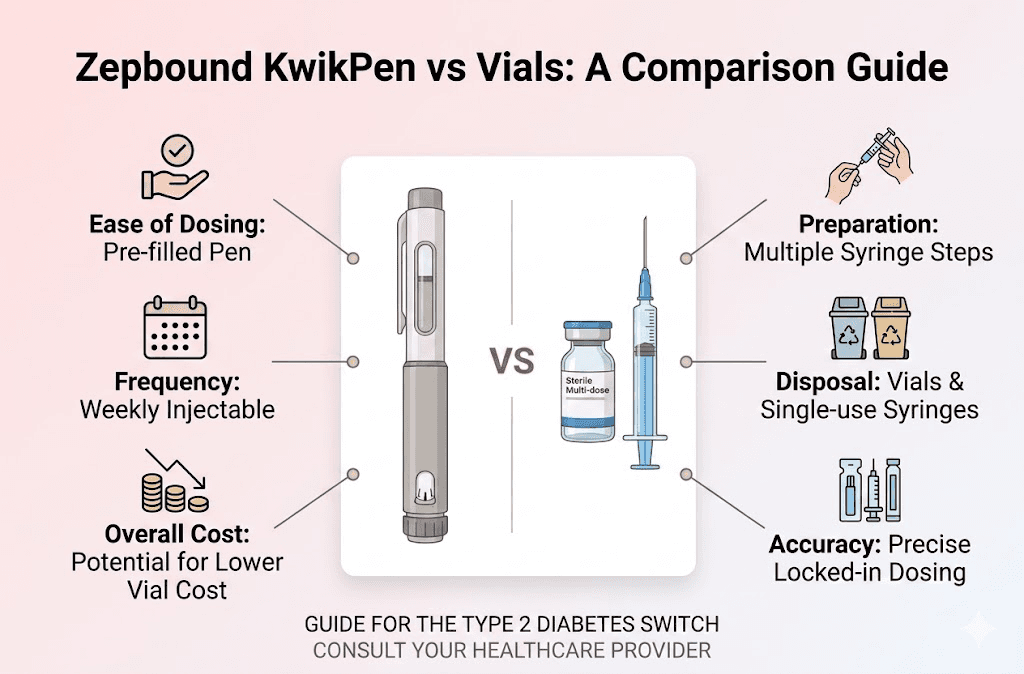
The newly introduced multi-dose KwikPen changes the format in three highly meaningful ways:
- Multi-dose design: Unlike the single-use pens that come pre-loaded with just one dose, the KwikPen is a reusable injector device that contains four doses (a full month's supply). This means fewer individual pens taking up refrigerator space, a significant reduction in environmental plastic waste, and a very familiar feel for anyone who has managed insulin pens in the past.
- Dose dialing: The KwikPen allows you to dial your dose manually. For patients whose prescribers adjust their tirzepatide dose over time—which is standard clinical practice during the titration phase—this adds an excellent layer of flexibility.
- Needle attachment: With the KwikPen, you attach a small, sterile needle tip before each injection. This is an extra step compared to the classic autoinjector, but it also means you control the injection depth and angle more precisely.
The vial format, by contrast, requires drawing medication into a separate syringe. This step introduces more room for minor dosing errors, requires a bit more manual dexterity, and adds preparation time. The KwikPen eliminates the syringe-drawing process entirely.
The Real-World Time Test
Here is the honest breakdown of what those 41 seconds looked like:
- Seconds 1–8: Remove KwikPen from the fridge, attach the fresh needle tip, and pull off the inner needle cap.
- Seconds 9–18: Dial to the prescribed dose, confirming the number in the dose window.
- Seconds 19–33: Pinch the skin at the injection site (such as the outer thigh or abdomen), insert the needle, press the dose button, and hold.
- Seconds 34–41: Remove the needle, recap it safely, and dispose of the needle tip in a sharps container.
For comparison, preparing a vial injection—drawing the correct volume into a syringe, carefully clearing out air bubbles, and occasionally swapping needles—averaged closer to 3 to 4 minutes in informal user reports and patient forums.
That is not a catastrophic difference if you are only injecting once a week. But psychologically, it matters. Injection anxiety is a highly common, legitimate clinical hurdle, and a longer prep time gives that anxiety more room to grow.
Furthermore, the KwikPen hurts less for many users. Because you control the insertion speed with a manual needle rather than relying on a forceful, spring-loaded mechanism, some users describe it as a softer, less startling experience. Others prefer the autoinjector's speed precisely because it's over instantly. This is a genuinely personal preference; there is no universal winner.
What is consistent across user experiences is the psychological shift: the KwikPen feels more like a calm, standard routine and less like a stressful medical event. As emphasized by the Centers for Disease Control and Prevention (CDC), managing obesity requires sustainable, long-term tools. If a delivery format makes your treatment plan easier to adhere to, it is a significant win for your health.
Should You Switch? Here's the Honest Verdict
The KwikPen isn't for everyone, and switching isn't a decision to make based on convenience alone. You and your medical provider should evaluate which delivery method fits your lifestyle, budget, and comfort level.
You are a strong candidate for the KwikPen if:
- You are still in the dose titration phase and your prescription is being regularly adjusted.
- You experience intense injection anxiety and find the loud "snap" of the autoinjector startling.
- You have used multi-dose insulin pens before and prefer that familiar, manual format.
- You want to consciously reduce your plastic waste footprint from single-use pens.
Stick with the autoinjector or vials if:
- You have already found a seamless, stress-free rhythm with your current format and it is working.
- Fine motor limitations (like arthritis) make manually attaching tiny needle tips difficult.
- Your insurance coverage or budget heavily favors the single-dose vial (which often has a lower direct-to-consumer self-pay price) or the traditional autoinjector.
Key questions to ask your doctor before switching:
"Is my specific prescribed dose currently available in the KwikPen format at my preferred pharmacy?" — Not all doses are available in every format at all times.
"Will switching formats affect my insurance prior authorization or monthly copay?"
"Can the clinical team provide a brief training session on proper needle attachment before my first dose?"
The bottom line: the multi-dose KwikPen is a genuine quality-of-life improvement for a specific type of user. It is not necessarily revolutionary, but for people who dread injection day, shaving minutes off the preparation process and gaining more physical control over the needle can make weekly treatments feel far more sustainable. And in medical weight management, sustainability is everything.
Maryland Trim Clinic (MTC) in Laurel, MD
Navigating the expanding options for weight loss medications—from vials to autoinjectors to the new multi-dose KwikPen format—can feel overwhelming to manage alone. Located in Laurel, MD, the Maryland Trim Clinic (MTC) provides the structured, medically supervised framework necessary to ensure your treatment is as comfortable, affordable, and effective as possible.
Rather than handing you a prescription and leaving you to figure out the mechanics by yourself, MTC supports you through every step of your journey. When you enroll in a customized medical weight loss program, our clinical team will walk you through the pros and cons of different GLP-1 weight loss injections and help you select the delivery method that best fits your lifestyle and budget. Beyond the medication, MTC incorporates essential holistic support, such as nutritional counseling and coaching, to ensure you are building the dietary habits required for long-term, sustainable health.
Medical Disclaimer: The information provided in this article is for educational purposes only and is not intended as a substitute for professional medical advice, diagnosis, or treatment. Always seek the advice of your physician regarding a medical condition, treatment options, or before altering your prescribed medication routine.
Frequently Asked Questions
Q: Is the Zepbound KwikPen available in all doses? A: Not always. KwikPen availability can vary by dose strength and pharmacy supply chains. Always check with your prescriber and pharmacist to confirm your specific dose is available in the KwikPen format before requesting a prescription switch.
Q: Does the KwikPen hurt more than the autoinjector? A: Many users report the KwikPen feels gentler because you control the insertion speed manually, rather than relying on a sudden spring mechanism. However, this is highly personal—some users prefer the sheer speed of the autoinjector. Both formats use very fine needles designed to minimize discomfort.
Q: Can I switch from vials to the KwikPen mid-treatment? A: Yes, in most cases you can switch formats mid-treatment as long as your dose remains the same and your prescriber approves the change. Your doctor will simply need to update your prescription format with the pharmacy.
Q: Is the KwikPen more expensive than the single-use autoinjector? A: Cost depends heavily on your insurance plan and whether you are utilizing Eli Lilly's direct-to-consumer self-pay programs. In some cases, the formats are priced similarly; in others, the vial format may offer a cheaper self-pay option. Always verify with your insurance provider and pharmacy before switching to avoid unexpected out-of-pocket costs.
Q: How do I dispose of KwikPen needles safely? A: Used needle tips should be placed in an FDA-cleared sharps disposal container immediately after use. Never recap the base or break needles. Many pharmacies offer sharps disposal programs or can direct you to a local, safe drop-off site.
Ready to Streamline Your Weight Loss Journey?
Don't let injection anxiety or confusion over medication formats hold you back from achieving your health goals. Visit the Maryland Trim Clinic homepage today to schedule a comprehensive consultation. Our expert clinical team in Laurel, MD, will help you find the right medication format and build a sustainable, effective plan tailored just for you.