Zepbound Side Effects vs. Foundayo Pill: A Safety Guide

If Zepbound's side effects are stopping you in your tracks, could a daily pill be the answer—or does it come with the exact same problems?
This is one of the most common questions circulating in medical weight loss communities right now. With the development of Foundayo (orforglipron)—the first oral, non-peptide GLP-1 receptor agonist designed for weight management—patients are finally envisioning a genuine choice between an injection and a pill.
But choosing a medication based on convenience alone could leave you blindsided by side effects you weren't expecting. The delivery method changes how your body processes the drug, which in turn changes how you feel day-to-day. Here is what the clinical data and real-world pharmacological science actually tell us about which option is easier on your body.
ACT 1: Comparing GI Side Effects — What the Trial Data Shows
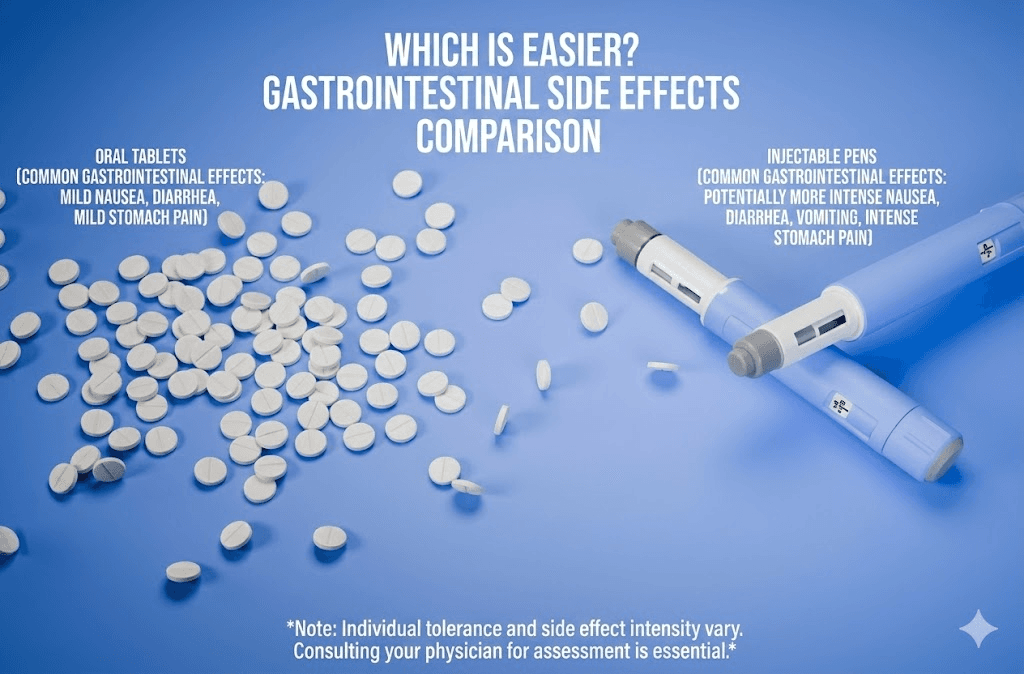
When evaluating any weight loss medication, gastrointestinal (GI) side effects are the primary hurdle most patients face. Here is how the two medications stack up based on clinical trials.
Zepbound (Tirzepatide) — The Injectable Benchmark
Zepbound, which received official approval from the FDA in late 2023, is a dual GIP and GLP-1 receptor agonist administered as a once-weekly subcutaneous injection. Its pivotal SURMOUNT trials provided some of the most detailed side effect data in obesity medicine to date.
In the SURMOUNT-1 trial, the most commonly reported adverse events were gastrointestinal:
- Nausea: Reported in approximately 28–33% of participants across the 5 mg, 10 mg, and 15 mg dose groups (compared to roughly 9% in the placebo group).
- Diarrhea: Affected around 19–23% of patients on active treatment.
- Constipation: Reported by 11–17% of patients, a side effect often underreported in public discussions but highly impactful to daily comfort.
- Vomiting: Occurred in approximately 8–13% of tirzepatide users.
The Reality Check: These side effects were most intense during the dose escalation phase—the period when patients step up from 2.5 mg to higher maintenance doses over several months. Most participants found that nausea and vomiting significantly diminished after stabilizing. Discontinuation due to GI events occurred in roughly 4–6% of trial participants, which is relatively modest.
Foundayo (Orforglipron) — The New Oral Contender
Orforglipron is a non-peptide, small-molecule GLP-1 receptor agonist. Unlike older semaglutide tablets that require strict fasting protocols and have limited absorption, orforglipron can be taken with or without food—a massive practical advantage.
However, in Phase 3 obesity trials, orforglipron's GI side effect rates looked strikingly familiar, and in some cases, slightly more pronounced:
- Nausea: Reported in approximately 32–41% of participants depending on the dose—notably higher than what was seen with Zepbound in equivalent comparisons.
- Diarrhea: Seen in roughly 18–25% of patients.
- Vomiting: Affected around 12–19% of patients.
- Constipation: Reported by approximately 10–14% of users.
Discontinuation rates due to GI side effects in orforglipron trials ranged from approximately 5–8%, making it marginally higher than Zepbound's figures.
The Takeaway From the Numbers
The uncomfortable truth is that switching from an injectable to an oral appetite suppressant medication doesn't automatically mean fewer GI side effects. In some trial comparisons, orforglipron's nausea rates actually trend slightly higher than tirzepatide's. The pill is not a softer ride—it's simply a different ride.
ACT 2: Why Delivery Method Changes How Side Effects Hit
Understanding the raw percentages is only half the story. The way side effects occur—their timing, predictability, and duration—differs meaningfully between injections and pills. That difference has real consequences for your daily life.
The Injectable Experience: Predictable Peaks
With Zepbound, the drug is administered subcutaneously once per week. After injection, tirzepatide is absorbed gradually into the bloodstream, reaching peak plasma concentration roughly 8 to 72 hours post-injection.
- The Benefit of Predictability: Most patients using GLP-1 weight loss injections can anticipate exactly when they are most likely to feel nauseous. Many users learn to schedule their shots strategically—such as on a Friday evening—so that peak nausea hits over a weekend when they can rest.
- Gradual Onset: The slow absorption from the subcutaneous depot tends to produce a more gradual onset of symptoms, which many describe as more manageable than sudden, acute nausea.
The Oral Experience: Daily Dosing, Daily Variability
Foundayo is taken daily. This is both its greatest advantage and its biggest complication.
- The Challenge of Daily Peaks: Daily dosing means the drug reaches peak plasma levels once every 24 hours. For patients in the early weeks of treatment, that means a potential daily encounter with nausea rather than a single weekly wave. You cannot easily "plan around" daily nausea.
- The Silver Lining of a Shorter Half-Life: Because each daily dose delivers a smaller absolute amount of the drug, some patients find the individual episodes of nausea feel less intense—more of a persistent mild queasiness. Furthermore, if side effects become intolerable, oral medications clear the system within 24–48 hours, whereas injectables persist in the body for over a week.
Absorption, Food, and the Gut Wall
There is a physiological factor at play. Oral GLP-1 medications activate receptors in the gastrointestinal tract directly during absorption. According to research published by the National Institutes of Health (NIH), the local activation of enteric GLP-1 receptors in the gut wall directly influences gastric motility. This direct exposure during digestion may partially explain why acute nausea rates trend slightly higher with oral agents. Zepbound, conversely, reaches those same GI receptors via the bloodstream.
ACT 3: The Verdict — Who Tolerates Which Option Better?
There is no universal winner here. The better medication depends heavily on your individual biology, lifestyle, and which specific side effects you tolerate best.
You May Do Better With Zepbound (Injectable) If:
- You value predictability: If you prefer organizing your week around a known 48-hour nausea window to guarantee five days of relative normalcy.
- You don't mind needles: Autoinjector pens have reduced the skill and pain barrier considerably.
- You struggle with daily pills: Once-weekly dosing has well-documented adherence advantages over daily regimens. Missed oral doses can cause GI symptoms to fluctuate unpredictably.
- You suffer from severe GERD: Oral medications must pass through an already-sensitive esophagus. The injectable route bypasses the upper GI tract during initial absorption entirely.
You May Prefer Foundayo (Oral Pill) If:
- You have severe needle phobia: This is the most legitimate use case. For patients with intense injection anxiety, a slightly higher nausea rate is a perfectly acceptable trade-off.
- You prefer mild, distributed discomfort: Some individuals find a low-grade daily queasiness easier to manage than a pronounced two-day wave of nausea.
- You travel frequently: Oral pills are room-temperature stable, eliminating the anxiety of traveling with refrigerated injectable pens.
- You want a faster "exit strategy": If side effects become overwhelming, stopping a daily pill provides relief within a day or two, compared to waiting a week for an injection to wear off.
Maryland Trim Clinic (MTC) in Laurel, MD
Deciding between an injectable like Zepbound and an oral medication like Foundayo shouldn't be based on guesswork. It requires a careful medical evaluation of your lifestyle, digestive health, and weight loss goals. Located in Laurel, MD, the Maryland Trim Clinic (MTC) offers the expert, personalized guidance you need to navigate these complex choices safely.
At MTC, we understand that managing side effects is just as important as losing the weight. When you participate in a customized medical weight loss program, our clinical team helps you monitor your body's response to medication—whether injectable or oral. By combining your prescription with targeted nutritional counseling and coaching, we help you implement dietary strategies that actively reduce nausea, prevent muscle loss, and make your weight loss journey as comfortable and sustainable as possible.
Final Thoughts
The development of oral GLP-1s marks a genuinely important moment for weight loss medicine—patient choice is expanding in meaningful ways. But the assumption that "the pill is gentler" doesn't cleanly align with the clinical data.
Both Zepbound and orforglipron carry real GI side effect burdens, particularly during dose escalation. The differences lie in the pattern and timing of those side effects, not necessarily their frequency. For many patients, the choice will ultimately come down to needle preference, lifestyle flexibility, and which side effect pattern they can most realistically build their routine around.
Medical Disclaimer: The information provided in this article is for educational purposes only and does not constitute medical advice. Side effects and results vary by individual. Always consult your healthcare provider or a qualified physician before starting, changing, or stopping any medical weight loss treatment.
FAQs
Does switching from Zepbound to an oral GLP-1 reduce nausea? Not necessarily. Clinical trial data shows that orforglipron's nausea rates are comparable to—and sometimes slightly higher than—tirzepatide's. The pattern changes to a daily occurrence rather than a weekly peak, but the overall frequency does not decrease just because it is a pill.
Is Foundayo (orforglipron) FDA-approved for weight loss? Orforglipron has advanced through clinical trials for obesity management with positive results. Because regulatory statuses update frequently, patients should confirm the current FDA approval status and availability directly with their prescribing healthcare provider.
Why does tirzepatide (Zepbound) cause nausea at all? Tirzepatide activates GLP-1 receptors, which intentionally slow gastric emptying. Slowed digestion causes food to sit in the stomach longer, which triggers the brain's nausea centers and can lead to bloating and vomiting, especially if large meals are consumed.
Can I take anti-nausea medication with Zepbound or orforglipron? Many clinicians recommend over-the-counter options like ginger or prescribe anti-nausea medications (like Zofran) during dose escalation. However, always consult your prescriber first, as some anti-nausea drugs affect GI motility and could interact with your weight loss medication.
What is the main practical advantage of an oral GLP-1 over Zepbound? The primary advantages are the complete elimination of needle injections, room-temperature storage stability (no refrigeration required), and ease of travel.
Is one medication better for patients with GERD or acid reflux? For patients with significant GERD or esophageal conditions, the injectable route (Zepbound) is often preferred. It bypasses direct esophageal and upper GI exposure during absorption, whereas oral pills must pass directly through the digestive tract.
Ready to Find the Weight Loss Solution That Fits Your Body?
Don't navigate severe side effects alone. Visit the Maryland Trim Clinic homepage today to schedule a comprehensive consultation. Our medical experts in Laurel, MD, will help you evaluate your options, manage your symptoms, and achieve your health goals comfortably and safely.