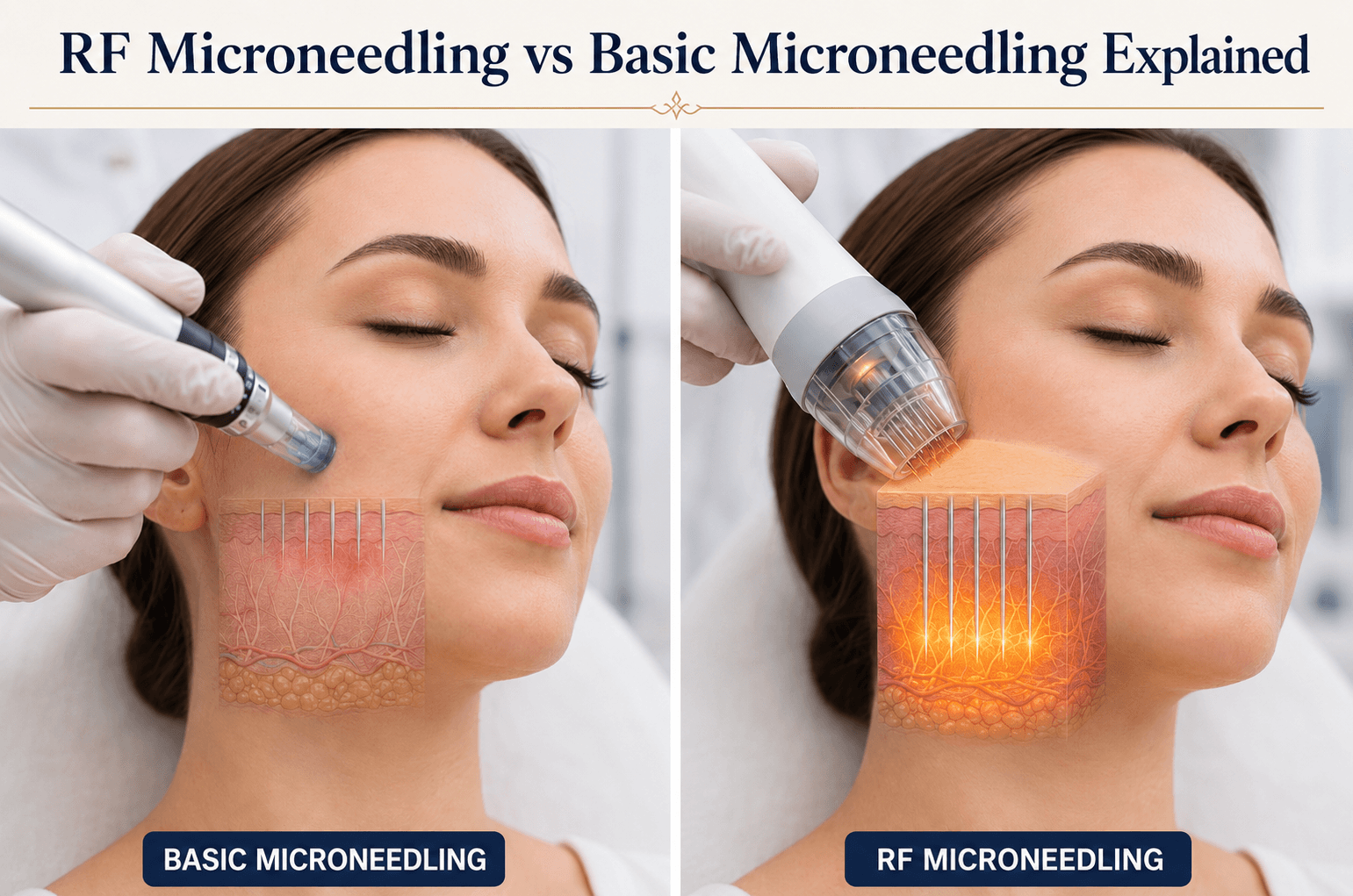
RF Microneedling vs Basic Microneedling Explained


They both use needles, but what happens after the needle goes in is completely different.
If you have been researching skin treatments and found yourself staring at words like Morpheus8, collagen induction therapy, or radiofrequency remodeling, you are not alone. Most people looking for a tightening or anti-aging treatment hit the same wall of jargon. At Maryland Trim Clinic, we think the simplest way to compare RF microneedling and basic microneedling is to start with mechanism: what tissue layer is being treated, and what kind of repair response is being triggered?
This guide explains the difference in plain terms so you can walk into a consultation knowing what to ask for, what to expect, and when a more advanced treatment is actually worth considering.
What Radiofrequency Energy Does to Your Skin

The thing that makes RF microneedling fundamentally different is radiofrequency energy.
Radiofrequency, or RF, is a form of electromagnetic energy. When it is delivered into tissue, it creates controlled heat below the surface of the skin. The goal is not to burn the top layer. The goal is to create a precise thermal signal in deeper tissue where collagen support, skin laxity, and in some cases subdermal fat structure can affect the way the face or body looks.
Collagen is a structural protein in the dermis, the layer beneath the outer epidermis. When collagen fibers are exposed to controlled heat at the right temperature, they contract. That immediate contraction can create subtle tightening. More importantly, the controlled injury triggers wound repair and new collagen formation over the following weeks and months.
That is why RF microneedling is often discussed alongside non-surgical skin tightening, targeted fat reduction, and broader non-invasive body contouring. It is not just a surface texture treatment. In the right candidate, it is a deeper remodeling treatment.
The FDA has also warned that RF microneedling should be used carefully for appropriate candidates, which is why provider skill matters. Their radiofrequency microneedling safety communication is a useful reminder that energy-based procedures are medical-device treatments, not casual spa add-ons.
Why Basic Microneedling Works Closer to the Surface
Basic microneedling, also called collagen induction therapy, is still a legitimate treatment. It simply works on a different principle.
A microneedling pen creates tiny controlled punctures in the skin. Your body reads those micro-channels as a minor injury and begins repair. That repair response can increase collagen and elastin, improve circulation, and support smoother texture over time. It is commonly used for enlarged pores, mild acne scarring, superficial fine lines, uneven tone, and product absorption.
Most standard microneedling depths stay in the upper-to-mid dermis. That can be enough for texture and mild scarring. It is not usually enough for significant tightening, jowling, loose neck skin, or deeper structural concerns. A systematic review of microneedling for atrophic acne scars supports microneedling as a meaningful option for certain scar patterns, but that evidence should not be stretched into claims about lifting or fat remodeling.
This is where patients can feel disappointed. They hear "microneedling," see dramatic tightening results online, and assume the same result is possible with a standard pen. Often, those dramatic results came from RF microneedling, not basic microneedling.
The Depth Difference Is the Real Difference
The simplest way to think about the two treatments is this:
- Basic microneedling creates a controlled surface-level wound response.
- RF microneedling creates controlled needle injury plus deeper thermal remodeling.
For surface texture, pores, early fine lines, mild acne scarring, and uneven tone, basic microneedling can be a practical starting point. For laxity, early jowls, loose neck skin, deeper acne scarring, and skin that needs more structural tightening, RF microneedling is often the stronger conversation.
This does not mean RF is automatically better for everyone. A patient with mild texture concerns may not need the cost, downtime, or intensity of RF. A patient who wants lower-face tightening, however, may waste time and money doing basic microneedling sessions that were never designed to solve that problem.
How to Know Which Treatment You Are Being Offered
Because both treatments involve needles, redness, numbing cream, and collagen language, it is easy to book one while thinking you are getting the other. Before paying, ask direct questions.
Ask for the device name. RF microneedling devices are specific platforms, such as Morpheus8, Vivace, Genius RF, Sylfirm X, Potenza, or Secret RF. Standard microneedling devices include pens and non-energy devices that do not deliver radiofrequency heat.
Ask whether the device delivers energy. A clear answer should sound like: yes, this device delivers RF energy through the needles at a selected depth. If the provider cannot explain the energy setting, depth, and recovery expectations, slow down.
Ask what result the provider is promising. Basic microneedling should not be sold as a dramatic lifting treatment. RF microneedling should not be treated like a no-downtime facial. The more accurately the provider explains the tradeoffs, the safer the decision becomes.
Patients comparing skin procedures often find it helpful to read our broader guide to body contouring technology, especially if they are deciding whether their concern is skin, fat, muscle, or a combination. If you are comparing device strength and safety, the article on professional versus at-home body contouring results makes a similar point: the tool and the operator both matter.
How Maryland Trim Clinic Helps Match Treatment to the Concern
At MTC, the right treatment starts with identifying the real tissue problem. Is the concern surface texture, acne scarring, laxity, neck looseness, jawline definition, or body skin changes after weight loss? Those are different problems, and they do not all respond to the same device.
For some patients, an RF discussion belongs inside a broader plan that may include 3D body scanning, muscle building and toning, or a medical weight loss program when loose skin or body contour changes are tied to larger weight changes.
For facial and skin concerns, an MTC consultation can help you compare downtime, cost, skin tone safety, treatment depth, and realistic expectations. That matters because the best treatment is not the most intense one. It is the one that actually matches the concern.
Bottom Line
Basic microneedling and RF microneedling are both real treatments. The problem is not that one is good and the other is bad. The problem is that they are often marketed under the same broad word, even though they work very differently.
If your goal is smoother surface texture, basic microneedling may be enough. If your goal is tightening, deeper collagen remodeling, lower-face definition, or more significant scar remodeling, RF microneedling may be the more appropriate option.
If you want a clinician to help you sort that out before you pay for the wrong treatment, Maryland Trim Clinic can help you compare the options carefully.
Frequently Asked Questions
Is RF microneedling the same as Morpheus8?
Morpheus8 is one brand of RF microneedling device. All Morpheus8 treatments are RF microneedling, but not all RF microneedling is Morpheus8.
Which hurts more: RF microneedling or basic microneedling?
RF microneedling is usually more intense because it adds heat energy below the skin. Both treatments are typically performed with numbing cream, but RF often feels warmer and deeper.
How many sessions will I need?
Basic microneedling is often done in a series of three to six sessions. RF microneedling may require fewer sessions, often one to three, though the right plan depends on the concern, settings, and skin response.
Can I do basic microneedling at home?
At-home rollers are not the same as professional microneedling and can cause irritation, infection, or worsening of active acne when used incorrectly. RF microneedling cannot be replicated safely at home.
Is RF microneedling safe for darker skin tones?
It can be appropriate for many skin tones when performed by an experienced provider using suitable settings. However, any needling or energy-based treatment can trigger post-inflammatory hyperpigmentation if the skin is overtreated or aftercare is poor.
Need Help Choosing the Right Skin Treatment?
Maryland Trim Clinic can help you compare standard microneedling, RF microneedling, and other non-surgical options based on your skin goals, downtime tolerance, and medical history.