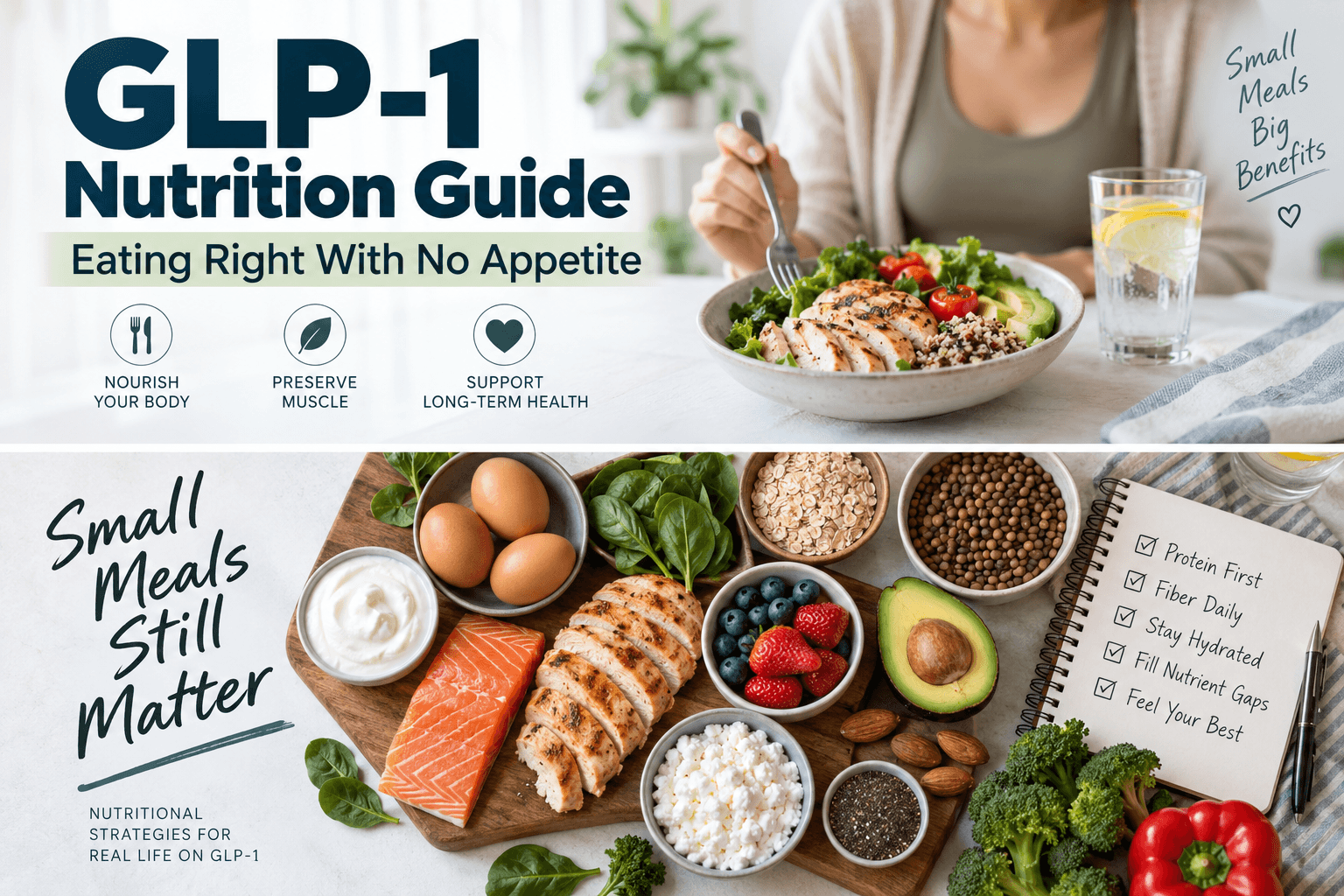
GLP-1 Nutrition Guide: Eating Right With No Appetite


You're losing weight on GLP-1, but you might also be losing your health without this plan. GLP-1 medications like semaglutide and tirzepatide work by suppressing appetite and slowing gastric emptying, which is exactly why the weight comes off. It is also exactly why so many users end up under-fed in the nutrients that matter most, even while their body weight drops steadily on the scale.
The core problem is simple to state and harder to solve: these medications remove the hunger signal that normally tells you to eat enough protein, fiber, and micronutrients across the day. Without a deliberate eating strategy, most people default to eating less of everything, including the nutrients they cannot afford to lose. This guide breaks down how to structure protein intake, cover nutrient gaps, and time meals so the medication supports your health instead of quietly undermining it.
Maryland Trim Clinic note: At Maryland Trim Clinic in Laurel, MD, GLP-1 treatment can be paired with nutritional counseling, metabolic testing, and progress tracking so reduced appetite does not become an excuse to ignore protein, energy needs, or body composition.
Getting Enough Protein When You Can Barely Eat
Why protein becomes the priority nutrient
GLP-1 drugs slow how quickly food leaves your stomach. That is useful for appetite control, but it also means your daily eating window shrinks. If you are only comfortable eating two or three small meals a day, protein is the nutrient most likely to fall short, because it typically requires more volume and chewing than refined carbohydrates or liquids.
This matters because rapid weight loss without adequate protein does not just remove fat. It removes lean muscle mass along with it. Several clinical observations of GLP-1 users show that a meaningful portion of total weight lost can come from muscle rather than fat, especially when protein intake is low and physical activity is minimal. Losing muscle lowers metabolic rate, reduces strength and mobility, and makes long-term weight maintenance harder once the medication is reduced or stopped.
How much protein is actually needed
Most clinical guidance for GLP-1 users lands in the range of 1.2 to 1.6 grams of protein per kilogram of body weight per day, though individual targets depend on starting weight, activity level, and any kidney or metabolic conditions. This is higher than the general population recommendation and higher than most people naturally eat when appetite is suppressed.
A practical way to think about it:
- A 70 kg (154 lb) adult on the lower end would target roughly 84 grams of protein daily.
- On the higher end, that same person might aim for 112 grams daily.
- Spreading this across 3 to 4 small meals means each meal needs 20 to 30 grams of protein, which is a lot to fit into a small, appetite-suppressed portion.
Practical strategies for hitting protein targets
Eat protein first, every meal. When your stomach fills quickly, whatever you eat first is what actually gets absorbed in meaningful volume. Structuring meals so protein is the first thing on the fork, before vegetables or starches, ensures it does not get crowded out.
Choose protein density over portion size. A 100 gram portion of Greek yogurt, cottage cheese, or a protein shake delivers far more protein per bite than an equivalent portion of chicken breast or beans. When stomach capacity is limited, density matters more than variety.
Use liquid and semi-liquid protein sources strategically. Protein shakes, bone broth with added protein, and smooth cottage cheese blends bypass some of the chewing fatigue and early fullness that solid protein triggers. These are not replacements for whole food but useful bridges on low-appetite days.
Space protein across the day rather than front-loading it. Trying to eat 40 grams of protein in one sitting when your stomach empties slowly often backfires into nausea. Smaller, more frequent protein doses are usually better tolerated.
The Nutrients GLP-1 Makes Hard to Consume
Protein gets most of the attention, but it is not the only nutrient at risk. Reduced food volume and food aversions common with GLP-1 medications also squeeze out fiber, key vitamins, minerals, and hydration.
Fiber and gut health
Ironically, fiber intake often drops on GLP-1 medications even though constipation is one of the most common side effects. This happens because fiber-rich foods like raw vegetables, whole grains, and legumes take up stomach volume that users often reserve for protein or simply cannot tolerate when nauseated.
Low fiber combined with slowed gut motility is a direct path to constipation, bloating, and discomfort that can further suppress appetite. A soluble fiber supplement (such as psyllium husk) taken with adequate water is often easier to tolerate than trying to eat large fibrous meals.
Hydration and electrolytes
Nausea, reduced thirst cues, and lower food intake all reduce fluid consumption. Since a portion of daily fluid normally comes from food itself, eating less means drinking less without realizing it. Dehydration on GLP-1 medications is common and can worsen headaches, fatigue, and constipation.
Electrolytes, especially sodium and potassium, can also run low when overall food intake drops. Adding an electrolyte packet or lightly salted broth on low-appetite days is a simple correction many users overlook.
Micronutrients at risk
Several vitamins and minerals are commonly under-consumed on GLP-1 medications because the foods that carry them are the first ones cut when appetite drops:
- Vitamin B12 — Common food source often reduced: Meat, dairy, eggs. Risk if under-consumed: Fatigue, nerve symptoms.
- Iron — Common food source often reduced: Red meat, legumes. Risk if under-consumed: Fatigue, hair thinning.
- Calcium — Common food source often reduced: Dairy, fortified foods. Risk if under-consumed: Bone density loss over time.
- Vitamin D — Common food source often reduced: Fatty fish, fortified foods. Risk if under-consumed: Bone and immune impact.
- Potassium — Common food source often reduced: Fruits, vegetables. Risk if under-consumed: Muscle cramps, fatigue.
This is not a reason to panic, but it is a reason to be deliberate. A basic multivitamin, periodic bloodwork through your prescribing provider, and attention to food variety (even in small portions) go a long way toward closing these gaps.
Supplement strategy: what to add and what to skip
Worth considering for most users:
- A daily multivitamin covering B12, iron, and vitamin D
- A whey, casein, or plant-based protein powder for meals where solid protein is hard to tolerate
- A soluble fiber supplement if constipation is an issue
- An electrolyte supplement on days with low food intake or increased activity
Use with more caution:
- High-dose single supplements (like iron) without bloodwork confirming a deficiency
- Meal replacement shakes as a full-time substitute for whole food, since they lack the fiber and micronutrient variety of real meals
- Any supplement stack without checking interactions with your prescribed medication
The tradeoff to keep in mind: supplements fill gaps efficiently, but they do not replace the benefits of whole food, including fiber structure, satiety signals, and nutrient combinations that isolated supplements cannot fully replicate. The goal is to use supplements to cover shortfalls, not to build a diet around them.
Meal Timing and Portion Strategies That Actually Work

Small, frequent, protein-anchored meals
Instead of trying to force three normal-sized meals, most GLP-1 users do better with 4 to 5 small meals or snacks spaced through the day. Each one should be anchored by a protein source first, with fiber and healthy fats added as tolerated.
A simple daily structure many users find workable:
- Morning: Protein shake or Greek yogurt with a small amount of fruit
- Midday: Small portion of lean protein with a soft, cooked vegetable
- Afternoon: Cottage cheese, a hard-boiled egg, or a protein bar
- Evening: Light protein-forward meal, smaller than what you'd eat pre-medication
- As needed: Broth, electrolyte drink, or fiber supplement on low-appetite days
Timing around injection day
Many users notice appetite and nausea are worse in the first 24 to 48 hours after a weekly injection. Planning your most nutrient-dense, protein-heavy meals for the days when appetite is relatively better, and leaning on liquid protein and broths on the harder days, keeps average daily intake more stable than trying to force normal meals on a bad-tolerance day.
Portion control that respects fullness cues
GLP-1 medications make it easy to overeat past the point of comfort before your brain registers fullness, because the physical fullness signal from a slowed stomach lags behind. Practical adjustments:
- Use smaller plates and bowls to make appropriate portions look complete rather than sparse.
- Pause halfway through a meal and wait a few minutes before deciding whether to continue.
- Stop at the first clear sign of fullness rather than eating until food is gone, since the discomfort of overeating on GLP-1 can last hours.
A decision framework for daily eating
When appetite is unpredictable, it helps to have a simple decision tree rather than relying on willpower each day:
- Can I tolerate a full small meal? If yes, prioritize protein first, then fiber, then fat.
- Am I nauseated or very low appetite? If yes, switch to liquid or semi-liquid protein and hydration, and don't force solid food.
- Have I eaten protein in the last 4 to 5 hours? If no, prioritize a protein source next, even a small one.
- Have I had fluids in the last 2 hours? If no, prioritize water or an electrolyte drink before anything else.
This kind of structured approach reduces the daily guesswork and helps prevent the common pattern of skipping meals entirely on low-appetite days, which compounds nutrient gaps over time.
Where Research and Data Tools Fit Into This Picture
This guide is focused on nutrition, but a growing number of people managing GLP-1 treatment also research supplement pricing, product availability, and marketing claims online, whether for personal use or because they are building tools, content, or comparison resources in this space. Comparing protein powder prices across retailers, checking regional availability of specific supplement brands, or verifying that supplement ads match actual product claims are tasks that often involve browsing multiple e-commerce sites and regional storefronts.
- Medical evaluation and medication monitoring
- Personalized nutritional counseling
- Metabolic testing to estimate resting energy needs
- 3D body scanning and progress tracking
- Long-term weight-maintenance support
For patients concerned about under-eating, low protein intake, or loss of lean mass, those services can be used together: nutrition counseling helps translate reduced appetite into a practical eating plan, metabolic testing can provide a more individualized view of energy needs, and repeat body-composition or 3D body scans can add context beyond scale weight alone.
At Maryland Trim Clinic in Laurel, Maryland, GLP-1 treatment is approached as part of a broader medical weight-loss plan rather than as a medication-only strategy. The clinic's current services include medical weight-loss evaluation, GLP-1 therapy with semaglutide or tirzepatide when appropriate, nutritional counseling, metabolic testing, and ongoing follow-up.
How Maryland Trim Clinic Supports Nutrition and Muscle Preservation
Common Mistakes to Avoid
- Skipping meals entirely on low-appetite days. Even a small protein shake is better than zero intake, since consistent under-eating compounds nutrient deficits over weeks.
- Ignoring fiber because it feels harder to eat. Constipation from low fiber often worsens appetite suppression, creating a negative cycle.
- Relying only on supplements and neglecting whole foods. Supplements fill gaps; they don't replace the broader nutrient and fiber profile of real meals.
- Not tracking hydration. Reduced food intake quietly reduces fluid intake too, since a portion of daily water normally comes from food.
- Comparing current appetite to pre-medication appetite. Trying to eat like you used to, in fewer, larger meals, usually backfires into discomfort and inconsistent nutrient intake.
- Not looping in a provider or dietitian for bloodwork. Nutrient deficiencies are easier to catch and correct early with periodic labs than after symptoms appear.
Conclusion
GLP-1 medications solve the appetite problem that made weight loss difficult, but they create a new problem: eating enough of the right things when hunger no longer tells you to. The core theme here is straightforward. Weight loss on GLP-1 is not automatically healthy weight loss unless protein, fiber, hydration, and key micronutrients are deliberately prioritized within a much smaller daily eating window.
The practical path forward is a protein-first, small-meal structure, supported by targeted supplementation where whole food falls short, and portion habits that respect the slower fullness signals these medications create. Building this into a repeatable daily routine, rather than relying on hunger cues that no longer show up reliably, is what separates sustainable, muscle-preserving weight loss from weight loss that quietly costs more than it should.
Frequently Asked Questions
How much protein do I actually need on a GLP-1 medication?
Most guidance suggests 1.2 to 1.6 grams of protein per kilogram of body weight daily, though individual needs vary based on starting weight, activity level, and health conditions. Confirm your specific target with your prescribing provider or a dietitian.
Why am I losing muscle even though the scale shows steady weight loss?
Rapid weight loss without adequate protein intake and resistance activity often includes lean muscle loss along with fat loss. This is common on GLP-1 medications because reduced appetite makes it harder to eat enough protein each day.
Are protein shakes a good substitute for meals on GLP-1?
They can be a useful bridge on low-appetite or nauseated days, but they should not fully replace whole food long term, since whole foods provide fiber and nutrient variety that isolated protein powders don't fully cover.
What causes constipation on GLP-1 medications and how do I manage it?
Slowed gastric emptying combined with lower food and fiber intake commonly causes constipation. A soluble fiber supplement, adequate hydration, and light physical activity often help more than trying to force large fibrous meals.
Do I need a multivitamin on GLP-1 medication?
Many users benefit from a daily multivitamin, especially covering B12, iron, and vitamin D, since reduced food volume often means these nutrients fall short. Bloodwork can confirm whether specific supplementation is needed.
How many meals should I eat per day on GLP-1?
Most users tolerate 4 to 5 small, protein-anchored meals or snacks better than 2 to 3 larger meals, since smaller portions are easier to tolerate with slowed gastric emptying.
Why does my appetite feel worse right after my weekly injection?
Nausea and appetite suppression are often strongest in the 24 to 48 hours after dosing. Planning lighter, liquid-forward meals during this window and more solid, nutrient-dense meals later in the week is a common workaround.
How do I know if I'm not getting enough nutrients on GLP-1?
Fatigue, hair thinning, muscle cramps, and unusual weakness can indicate nutrient gaps. Periodic bloodwork through your provider is the most reliable way to catch deficiencies before symptoms become significant.
Is it normal to not feel thirsty even when I'm not drinking much water?
Yes, reduced appetite and food intake can blunt thirst cues as well, since some fluid normally comes from food. Deliberately scheduling water or electrolyte intake, rather than waiting to feel thirsty, helps prevent dehydration.
How can Maryland Trim Clinic help me protect nutrition and muscle while using a GLP-1 medication?
Maryland Trim Clinic offers medically supervised weight-loss care in Laurel, MD, including GLP-1 therapy with semaglutide or tirzepatide when appropriate, nutritional counseling, metabolic testing, body-composition tracking, and ongoing follow-up. Your provider can use those tools to build a plan around your health history, appetite changes, and progress.
Need help building a GLP-1 nutrition plan?
If reduced appetite is making it hard to meet your protein, hydration, or nutrient needs, Maryland Trim Clinic can help you talk through your options and plan next steps with a consultation.